Linear induction motor equivalent circuit
QuickField simulation example
This example is prepared by the Toronto Metropolitan University.
To be able to include the motor into the circuit simulator it is necessary to calculate electric motor equivalent circuit parameters. To calculate parameters a no-load mode test and the fixed rotor test are carried out.
Tipo de problema
Problema plano-paralelo de AC magnetics.
Geometria
Z-length is 65 mm. Slot dimensions are 20*85 mm. Number of slots is 25.
Given
Rail is made of Aluminum 6061-T6 with electrical conductivity of σ = 35 MS/m.
Number of conductors in the slot is 24, current is 20 A (r.m.s). Frequency f = 50 Hz.
Task
Calculate the equivalent electric circuit parameters.
Solution
The resistance of the stator windings can be calculated from the winding geometric parameters as Rs = resistivity * Length / Conductor cross-section. The challenge is to calculate the inductances.
We are going to reproduce 2 experiments that you can do with the real motor: a synchronous motion speed regime and a locked rotor regime.
First we simulate the synchronous speed regime (slip value s=0). In this regime there are no eddy currents in the rotor as the rotor speed is equal to the speed of the magnetic field produced by the stator winding. This regime allows to calculate the sum of the stator leakage reactance value jXs and magnetizing reactance value jXm and the resistance corresponding to the losses in the core rm.
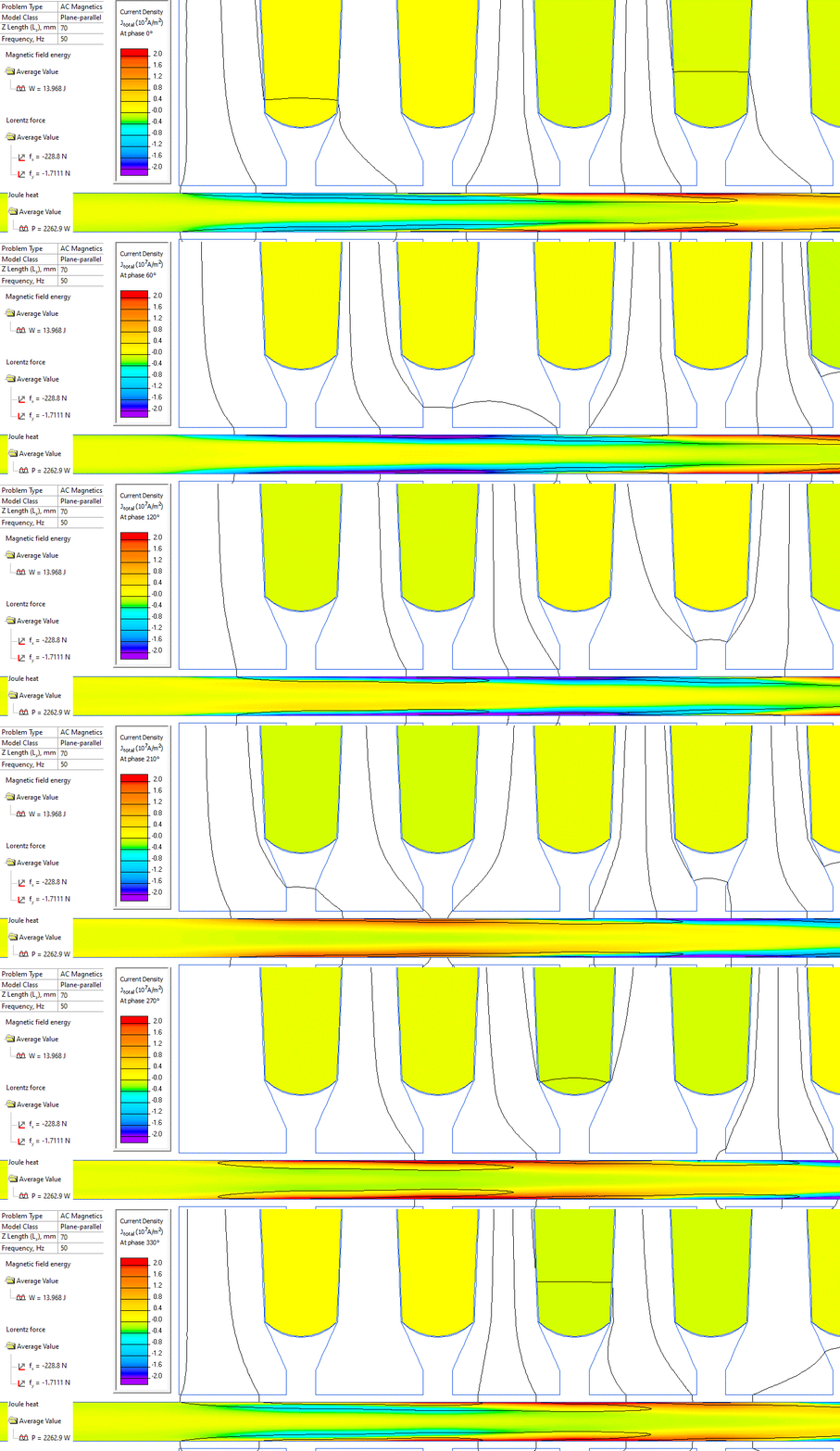
Then we simulate a locked rotor regime (slip value s=1). This regime allows to calculate jX1 + jX'r value. Also we will calculate the Joule heat losses in the rotor and find out rotor resistance R'r.
Unlike real experiments we have all field parameters readily available. The inductance is the ratio of the magnetic field energy doubled to the electric current value squared.
We do not draw each individual conductor in the slot, instead we draw a large block and specify the total current Is value and zero electrical conductivity. In this case the current density is uniformly distributed across the conductor cross-section.
Results
No load regime current Is = 20 A (r.m.s). Magnetic energy 12.3 J. Inductance Ls + Lm = 2*12.3 / 20² = 0.0615 H, reactance Xs + Xm = 2*π*f*Lm = 19.3 Ohm.
Core loss Pcore = 0.124 W. Resistance R'm = 0.124/20² = 0.31 mOhm.

Fixed rotor regime current Is = 20 A (r.m.s).
Joule heat in the rotor is 2292.9 W, rotor resistance R'r = 2292.9/20² = 5.73 Ohm.
Magnetic energy 13.968 J.
Reference: Induction motor, Wikipedia.
- Download simulation files (files may be viewed using any QuickField Edition).