ISO 10211:2007 Thermal bridges in building construction. Test case A.3 validation - QuickField simulation example
QuickField validation of the test case A.3 presented in ISO 10211:2007 Thermal bridges in building construction.
Engineering question
How to calculate heat flow and thermal coupling at an ISO 10211 case A.3 cold bridge?
Answer Solve the 3D wall/floor-slab corner model with the ISO convection boundaries, then calculate total heat flux, corner temperatures, and thermal coupling coefficients for comparison with the reference values.
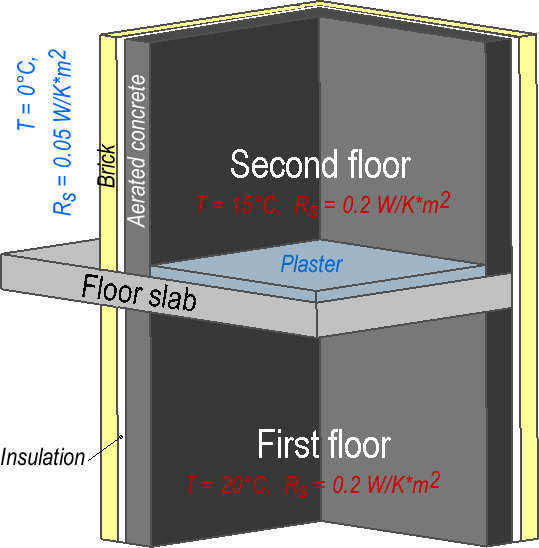
Task The floor slab penetrates the wall near the corner and forms the cold bridge. Determine the flux and the thermal coupling coefficients.
Solution Air contact surface thermal resistance Rs is caused by the convection. The convection coefficient value is reciprocal to the surface resistance value:
α = 1 / Rs [W/(K·m²)].
Thermal coupling coefficients (reference values are in the brackets).
External
First floor
Second floor
External
(1.000)
(0.000)
(0.000)
First floor
0.375 (0.378)
0.401 (0.399)
0.223 (0.223)
Second floor
0.329 (0.331)
0.216 (0.214)
0.455 (0.455)
To comply with the ISO 10211:2007 the difference between calculated and reference heat flux should be less than 2% (0.1°K - for temperature). This simulation accuracy complies with the requirements of ISO 10211:2007.