Stator ventilation duct - QuickField simulation example
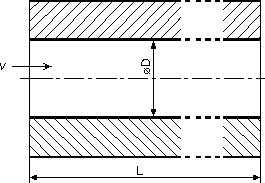
The air passes through the stator ventilation duct.
How to find air temperature rise in stator ventilation duct?
Answer Typical applications Geometry
D = 30 mm, L = 4000 mm.
Given
Task
Solution
dQ = q·t, where Then the air temperature rise is calculated as:
dT = dQ / (dV·C·ρ), where Results
After 3 iterations air temperature rise along the channel is dT = 21.81 °C
* Reference: John H. Lienhard IV, John H. Lienhard V, A heat transfer textbook.
Engineering question
Divide the duct into sections, calculate heat absorbed by the air in each section, and update the air temperature along the duct.
electric machine ventilation ducts, generator cooling channels, stator ventilation paths
Download
Simulation problem
Problem Type
Axisymmetric problem of heat transfer.
Air speed in the duct v = 10 m/s,
Duct surface convection coefficient α = 50 W/K-m²,
Pipe thermal load q = 300 W/m².
Determine the air temperature rise along the pipe.
The pipe is divided into n sections. The heat flux q from each section is calculated. The consumed energy dQ can be found as:
q - thermal flux (W),
t - duration of air passage through the section, t = (L / n) / v.
dQ - consumed energy (J),
dV - volume (m³),
C - thermal capacity of air (J / kg·K),
ρ - density of air (kg/m³).
Initial state: air temperature 0°C, thermal flux from the wall to the air q = 18.85 W (per one section), consumed energy dQ = 0.754 J, temperature rize per one section dT = 2.4 °C.
Related examples