Coaxial cylinders capacitance - QuickField simulation example
Mutual capacitance per unit length of two coaxial cylindrical conductors, with the calculated value compared against the analytical capacitance expression..
How to calculate the mutual capacitance of two coaxial cylinders and verify analytically?
Answer Typical applications Geometry
a = 5 mm, b = 10 mm.
Given
Task
Solution
Results
Reference: *Wikipedia, Capacitance.
Engineering question
Assign both cylinders as floating conductors, apply equal specified charges, and calculate capacitance from charge divided by their potential difference.
coaxial transmission lines, cylindrical capacitors, shielded cable structures
Download
Simulation problem
Problem Type
Plane-parallel problem of electrostatics.
Relative permittivity of air ε = 1,
Mutual capacitance per unit length of two coaxial cylindrical conductors, with the calculated value compared against the analytical capacitance expression. and compare it with analytical solution*:
C = 2πεε0 / ln(a/b) [F/m].
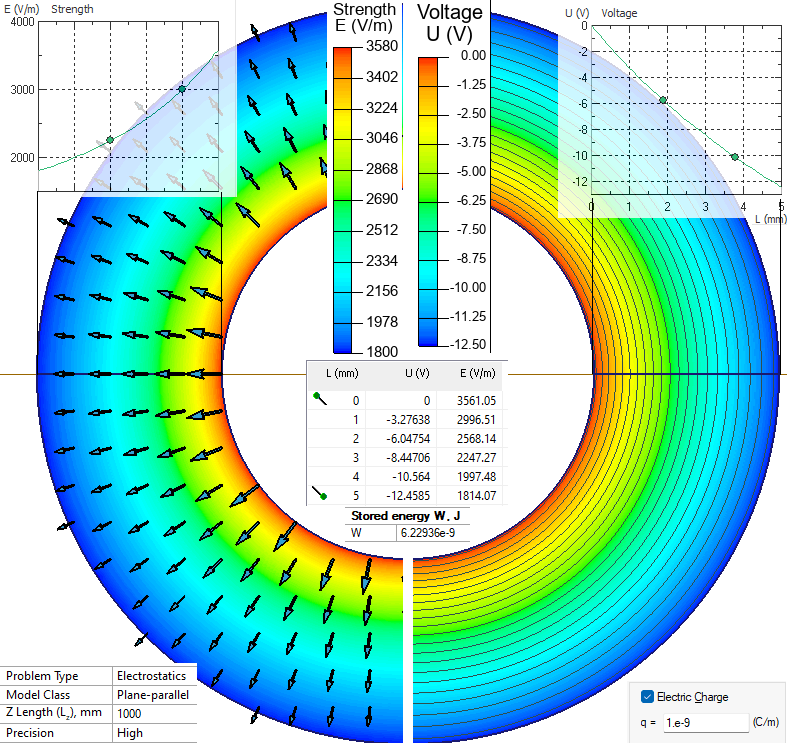
Each of the conductor's surface is marked as 'floating conductor', i.e. isolated conductors with unknown potential. At some point on each of conductor's surface the charge is applied q = 1 nC. The charge is then redistributed along the conductor surface automatically.
The capacitance can be calculated as C = q / ΔU
The measured potential difference is ΔU = 12.4585 V.
The capacitance is C = 10-9 / 12.4585 = 8.027·10-11 F = 80.27 pF per 1 meter of model length. Reference value* is 80.26 pF/m
Video
Related examples