Comb drive - QuickField simulation example
Electrostatic attraction force per tooth width in a MEMS comb drive, with numerical results compared against the corresponding two-dimensional analytical value.
How to find electrostatic force in MEMS comb drives?
Answer Typical applications Geometry 3D extrusion.
Given
Task
Solution
Results
* Comb drive, from Wikipedia, the free encyclopedia.
Engineering question
Calculate force for one symmetric tooth pair and compare the 2D and 3D results with the parallel-gap analytical expression.
MEMS comb actuators, electrostatic microdrives, micro-positioning structures
Download
Simulation problem
Problem Type electrostatics.
Comb thickness Lz = 40 um.
Gap between fingers d = 2.5 um.
Relative permittivity of air ε = 1,
Relative permittivity of comb ε = 10,
Potential difference ΔU = 40 V
Find the attraction force per tooth width and compare with 2D analytical solution:*
f = 0.5 · εε0 · n·Lz · U² / d,
where n is number of air gaps.
The simulation model includes only one pair of teeth (two air gaps, n=2). The Dn=0 boundary condition is applied on the plane of symmetry.
Analytical solution (force per one pair of electrodes, n=2):
f = 0.5 · 1 · 8.854e-12 · 2·40e-6 · 40² / 2.5e-6 = 2.27e-7 N.
Force f
Analytical solution
227 nN
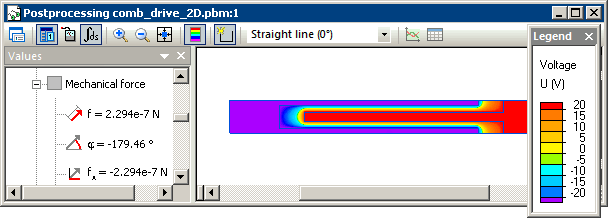
2D plane simulation
229 nN
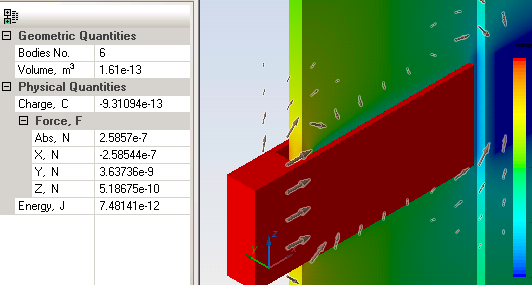
3D extrusion simulation
259 nN
Video
Related examples