Electric current distribution in the conductive laminated polymer films - QuickField simulation example
Current-density distribution in laminated conductive polymer films supplied through copper electrodes, including the effect of film and contact resistance.
How to find current distribution in laminated polymer films?
Answer Typical applications Geometry
Given
Task
Solution
For the electrodes connected to the DC voltage source we specify the electric potentials 0 and 24 V respectively. For the light fixture electrodes we specify the rated current 24V / 800 Ohm = 0.03 А defined as an external current in the central node.
Results
Engineering question
Set up a plane-parallel QuickField DC Conduction problem for laminated polymer films and evaluate current distribution from computed field results.
laminated conductive films, flexible conductive layers, polymer conductor laminates
Download
Simulation problem
Problem Type
Plane-parallel problem of DC conduction.
Films size 1x1 m. Cylindrical electrode diameters 1 mm. Hole diameters 2 mm.
Surface electric resistance of films Rs = 10 Ω/square, film thickness is t = 200 nm.
Copper resistivity is 56 MS/m
Light fixture with connecting electrodes has electrical resistance of 800 Ohm.
DC voltage source 24 V.
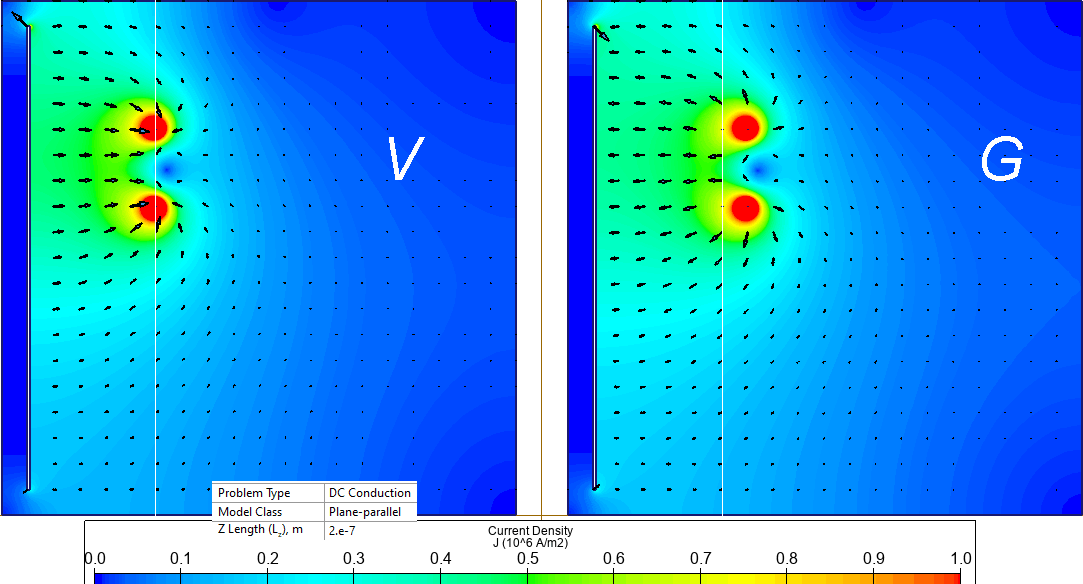
Find the current density distribution in the conductive films.
For the film we should specify the electrical conductivity, which is reciprocal to the product of the surface resistance and the film thickness: σ = 1/(Rs*t) = 1/ (10 * 200e-9) = 0.5 MS/m.
Current density distribution in the grounded electrode film (G) and powered electrode film (V).
Related examples