Cylindrical capacitor - QuickField simulation example
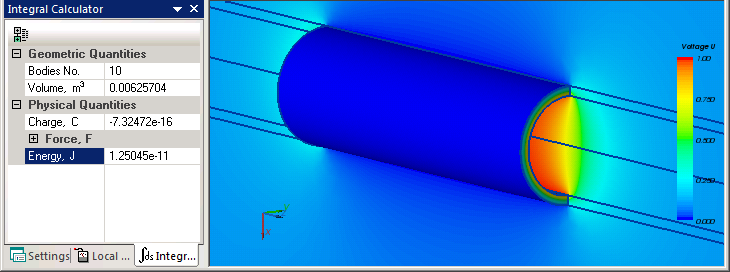
Capacitor consists of two coaxial cylindrical collinear electrodes. It may be simulated as 2D axisymmetric or 3D extrusion problem. Both approaches give same result and good correlation with analytical solution.
How to find capacitance of cylindrical capacitors?
Answer Typical applications Geometry
a = 5 mm, b = 6 mm, L = 40 mm.
Given
Task
Solution
QuickField simulation gives energy W and electric potential U distribution. The capacitance then can be calculated as C = 2W / ΔU².
Results
Engineering question
Calculate the stored electric energy in a 2D axisymmetric or 3D electrostatic model and use C = 2W/U^2; compare with the ideal cylindrical-capacitor formula.
cylindrical capacitors, coaxial electrodes, HV capacitor structures

Download
Simulation problem
Problem Type
2D axisymmetric/3D extrusion electrostatics.
Relative permittivity of media ε = 2,
Voltage difference ΔU = 1 V.
Find the capacitance of cylindrical capacitor.
Analytical solution gives the capacitance value of ideal cylindrical capacitor (without end effects) as
C = 2πεε0 * L / ln(a/b) [F]. *
Analytical solution (cylindrical capacitor without end effects):
C = 2*3.142*2*8.854e-12 * 0.04 / ln(0.006/0.005) = 0.4451e-11 / 0.1823 = 2.44e-11 F.
Energy W
Capacitance C
2D axisymmetrical simulation
1.24 pJ
2.48 pF
3D extrusion simulation
1.25 pJ
2.50 pF
Video
Related examples