End winding insulation - QuickField simulation example
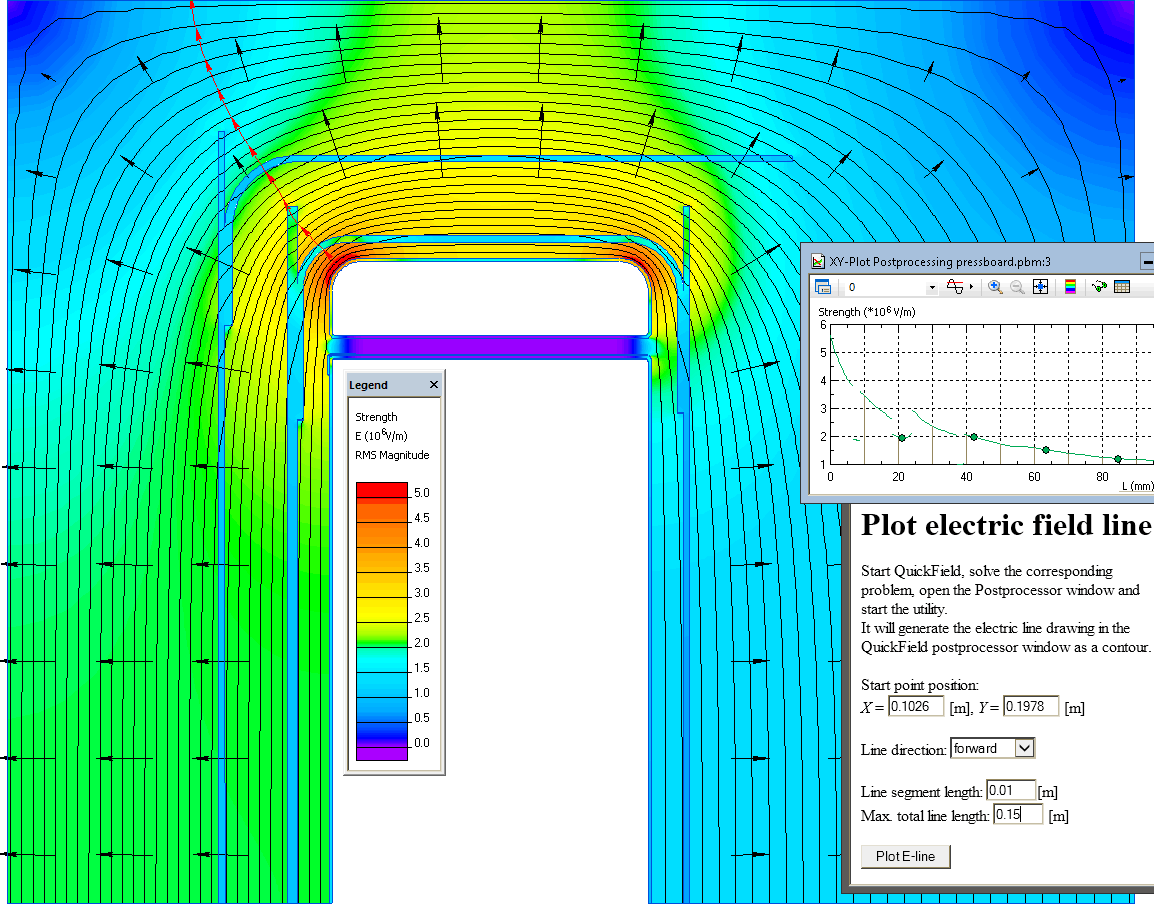
Electric field stress distribution in transformer end-winding oil gaps, identifying high-stress regions near winding ends and surrounding insulation structures. Solid
insulation is used to subdivide long oil gaps into smaller ones.
How to find electric field stress in transformer end-winding oil gaps?
Answer Typical applications Geometry
Given
Task
Solution
Results
Engineering question
Model the end-winding insulation axisymmetrically in AC conduction, use the peak value of the applied RMS voltage, and evaluate electric stress in the oil gaps.
transformer end-winding insulation, transformer terminal insulation, power transformer winding ends
Download
Simulation problem
Problem Type
Axisymmetric problem of AC conduction.
Relative permittivity of oil 2.2
Relative permittivity of paper 3.5
Relative permittivity of pressboard 4.5
Winding voltage = 200 kV (r.m.s.);
Static end ring (SER) voltage = 200 kV (r.m.s.);
Frequency f = 50 Hz.
Oil dielectric strength 20 kV/mm.
Calculate electric field stress distribution in the oil gaps.
In QuickField we should specify peak voltage value, which is 200000*sqrt(2) V.
Dielectric conductivity is very low, comparing to the conductivity of the steel core. Zero conductivity is specified for all dielectric materials.
Electric field lines tool is used to construct XY-plot along the E-line.
Electric stress distribution and electric potential lines.
Video
Related examples