Charging of the metal sphere through the current limiting resistor - QuickField simulation example
Example offered by K.Vostrov, student of the Electromechanical faculty of State Polytechnical University, St.Petersburg, Russia.
How to calculate the charging time and maximum current of a metal sphere charged through a current-limiting resistor?
Answer Typical applications Geometry
Given
Task
Solution
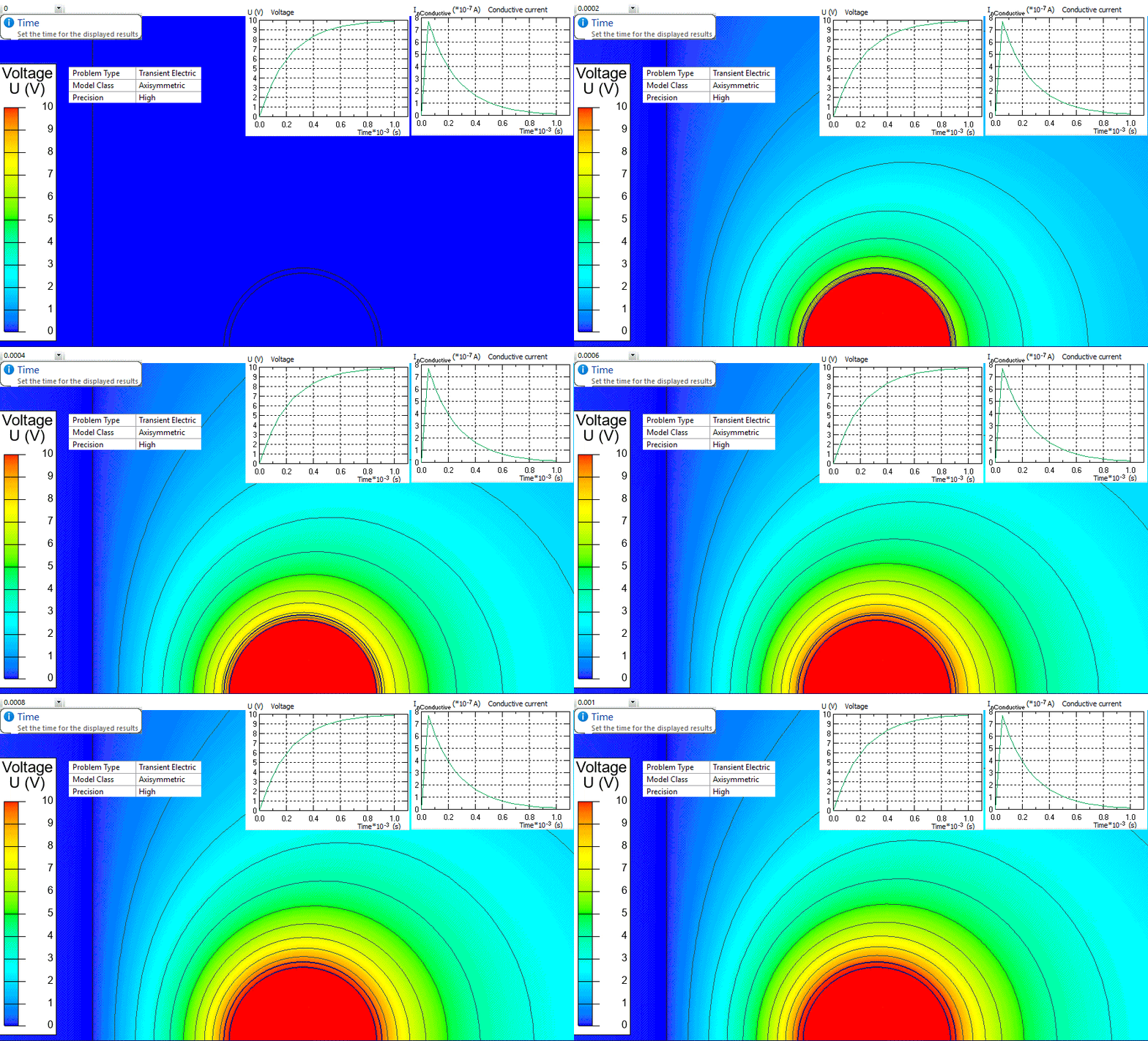
Results
* Reference: Resistance of hollow metal sphere, Physics Stack Exchange.
Engineering question
Set up an axisymmetric transient electric problem with the sphere, support rod and a thin resistive layer providing the current-limiting resistance; apply the source voltage on the inner surface of that layer and compute the energy versus time to obtain the charging current and time.
electrostatic sphere charging, RC charging circuits, high voltage sphere electrodes
Download
Simulation problem
Problem Type
Axisymmetric problem of transient electric.
Resistor R = 10 MOhm;
Nominal voltage E = 10 V.
Simulate the charging process, determine the charging time, and calculate the maximum current.
This system can be represented by an equivalent circuit with voltage source E, resistor R and capacitor C connected in series. Resistor R limits the charging current value.
The sphere itself is infinitely thin. Resistor R is modeled as a 10 mm thick resistive layer adjacent to the sphere, occupying the region between radius a = 140 mm and radius b = 150 mm.
For radial current flow through a spherical layer, resistance is:
R = ρ / (4π) · (1/a - 1/b)*
For R = 1×10⁷ Ohm, a = 140 mm, b = 150 mm, the layer resistivity is:
ρ = 4π·R / (1/a - 1/b) = 4π·1×107 / (1/0.140 - 1/0.150) ≈ 2.64×10⁸ Ohm·m.
QuickField input is conductivity, σ = 1/ρ = 1/(2.64×108) ≈ 3.79×10⁻⁹ S/m.
To get a pure resistor, without parasitic capacitance, we set the layer's relative permittivity to εr = 10-6 (it cannot be exactly zero in QuickField).
The sphere potential reaches 9.88 V after 1 ms, with a peak charging current of 1 µA.
Related examples