Epoxy spacer in HVDC gas insulated transmission line - QuickField simulation example
The spacer is used to support the conductor inside the outer housing.
How to calculate surface charge and electric field on an epoxy spacer in an HVDC GIL?
Answer Typical applications Geometry
Given
Task
Solution
Results
Engineering question
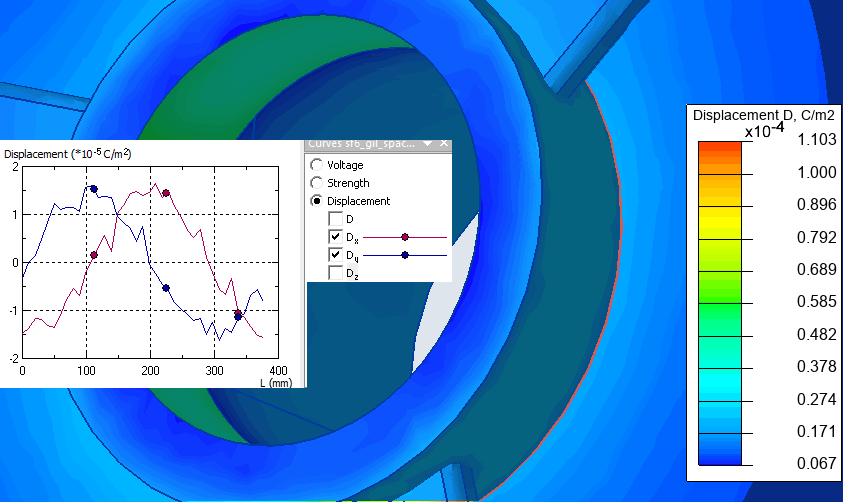
Solve a 3D electrostatic model of the epoxy spacer and SF6 insulation to obtain the surface-charge and electric-field distributions.
HVDC gas-insulated lines, GIS spacer supports, epoxy insulation spacers
Download
Simulation problem
Problem Type
3D-import electrostatics.
Electric permeability of SF6 gas is 1;
Electric permeability of epoxy is 7;
High voltage HVDC = 100 kV
Analyze the spacer's surface charge distribution and the related electric field.
Geometric model is built in a third-party CAD and imported into QuickField.
There is no field inside the metal conductors, so only the spacer and the gas- insulation are included in the model. An electric potential is set on the conductor's surface.
Surface charge density [C/m²] distribution along the spacer surface.
Related examples