Cable thermal resistance - QuickField simulation example
In this example we build thermal model of the high-voltage cable described in the IEC 60853-2 example F2*. Thermal resistances of the cable parts are calculated.
How to calculate the thermal resistances of cable layers and check against IEC 60853-2 values?
Answer Typical applications Geometry
Given
Task
Solution
In QuickField we should specify thermal conductivity [W/K*m] of materials, that is reciprocal to the thermal resistivity. Copper conductor thermal conductivity is 380 W/K*m, lead sheath thermal conductivity is 25 W/K*m.
Results
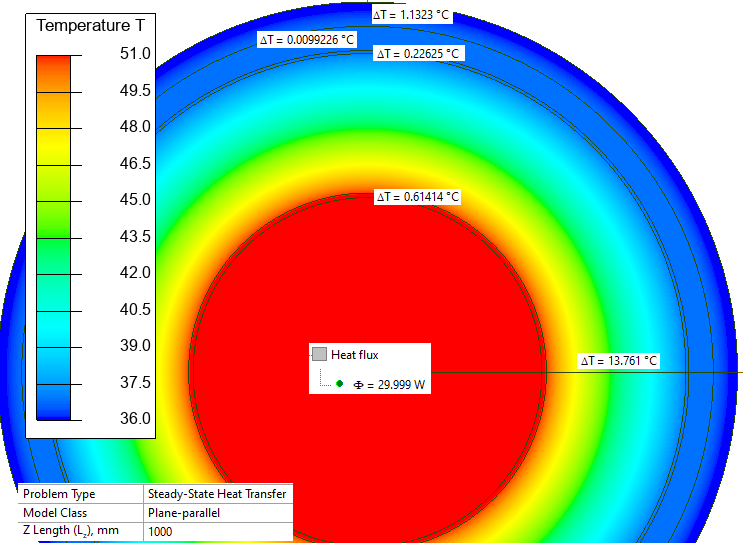
Temperature distribution along the radius of the cable.
References:
Engineering question
Apply a known heat loss, measure each layer's temperature drop, and divide that drop by heat flow per unit cable length.
load-cycle cable systems, utility cable networks,emergency current rating of cables
Download
Simulation problem
Problem Type
Plane-parallel problem of Heat Transfer.
Thermal resistivity of materials [K*m/W]: serving 3.5, oil/paper 5.0, soil 1. The semiconducting screens thermal conductivity is considered to be the same as that of the insulation, 5.0 K*m/W.
Calculate thermal resistances** of the cable parts and compare results with the reference values*.
Thermal resistance [K*m/W] = Temperature difference [K] / Heat flux per 1 meter of cable length [W/m]
To calculate the thermal resistance we are going to specify heat losses 30 W/m in the conductor and measure the temperature drop in cable layers.
Temperature drop conductor-sheath is (0.614+13.761+0.226) = 14.6°C, thermal resistance conductor-sheath is T1 = 14.6 / 30 = 0.487 K*m/W. Reference value* 0.488 K*m/W.
Layer
Temperature drop, K
Thermal resistance, K*m/W
QuickField
Reference*
Conductor screen
0.614
0.020
0.021
Insulation
13.761
0.4587
0.459
Core screen
0.226
0.0075
0.008
Sheath (lead)
0.01
0.00033
-
Serving
1.132
0.0377
0.038
* IEC 60853-2, Calculation of the cyclic and emergency current rating of cables. Part 2: Cyclic rating of cables greater than 18/30 (36) kV and emergency ratings for cables of all voltages.
** Wikipedia, Thermal resistance.
Related examples