Core reluctance - QuickField simulation example
Total magnetic reluctance of a ferromagnetic-core flux path, with the numerical result compared against the analytical magnetic-circuit calculation..
How to find magnetic reluctance of ferromagnetic cores?
Answer Typical applications Geometry
Given
Task
Solution
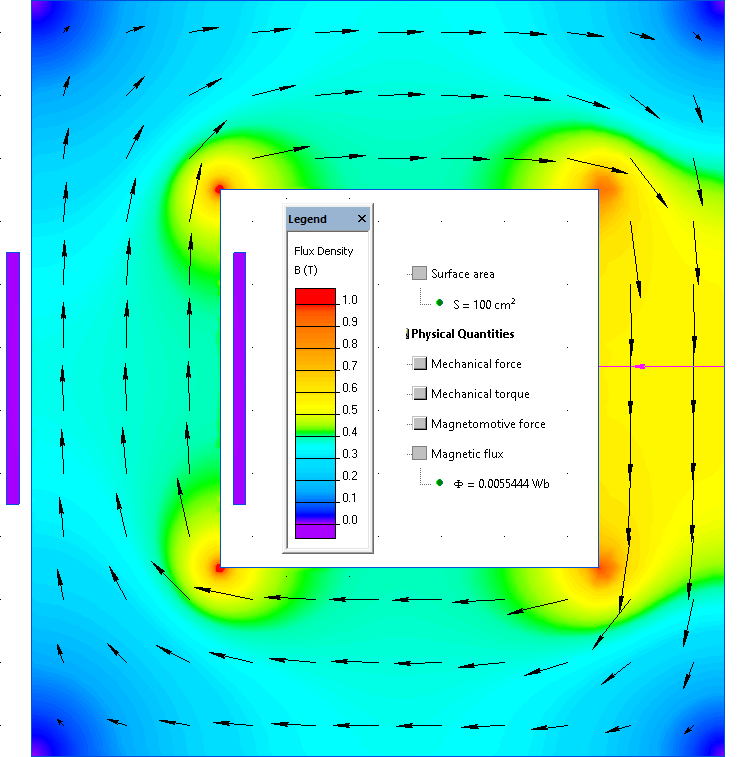
Results
*Reference
Engineering question
Model the coil by its total ampere-turns, calculate core flux, and obtain reluctance as magnetomotive force divided by flux.
ferromagnetic cores, magnetic circuit paths, transformer core structures
Download
Simulation problem
Problem Type
Plane-parallel problem of DC magnetics.
Core depth is 10 cm.
Relative permeability of the core is 2500;
Coil number of turns is 200, current I is 1 A.
Calculate the total reluctance of the flux path and compare it with the analytical solution.
We do not draw each individual turn. The coil is modelled as a block with the total ampere-turns specified.
Due to the crowding effect the actual magnetic flux path is shorter than the middle-line path used in the analytical calculations. So me may expect to get a higher flux value. Analytical solution* gives the flux value of 4.8 mWb
Magnetic flux value is 5.5 mWb, core reluctance is 200/0.0055 = 36.4 kA·turns/Wb.
Chapman, Stephen J. (2011). Electric Machinery Fundamentals (5th ed.). McGraw-Hill (p.14)
Related examples