Thermal conduction Fourier's law - QuickField simulation example
Engineering question
How to calculate heat flow through a flat wall and verify with Fourier's law?
Answer
Calculate heat flow from thermal conductivity, wall thickness, area, and surface temperature difference, then compare the finite-element result with the 16 W analytical value.
Typical applications
flat-wall thermal barriers, building insulation walls, layered thermal panels
Download
- Download simulation files (files may be viewed using any QuickField Edition).
Simulation problem
Problem TypePlane-parallel problem of steady-state heat transfer.
Geometry
Given
The temperature at the wall surfaces: T1= 20°C, T2= 60°C;
Thermal conductivity of the wall material λ = 0.4 W/K*m
Wall thickness d = 1 cm.
Wall surface area S = 100 cm².
Task
Heat flux through a flat wall under a specified temperature difference, with the calculated conductive heat flow compared against Fourier's analytical law.
Solution
According to Fourier's law*, the heat flux in a flat wall is directed from the hot surface to the cold one and is calculated using the thermal conductivity of the wall, its thickness and area, and the temperature difference:
Φ = λ * (T2-T1)/d * S.
*Wikipedia: Fourier's law
Result
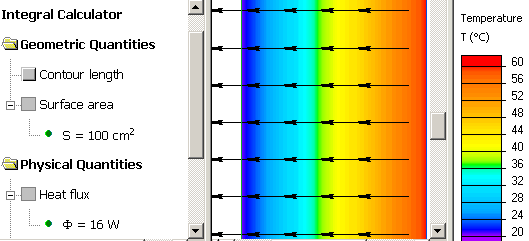
Analytic solution: Φ = 0.4 * (60-20)/0.01 * 100e-4 = 16 W.
Picture of a thermal field in QuickField, vectors show the directions of the heat flow
Video
- Thermal conduction Fourier's law. Watch on YouTube