Glass electric melter interelectrode resistance - QuickField simulation example
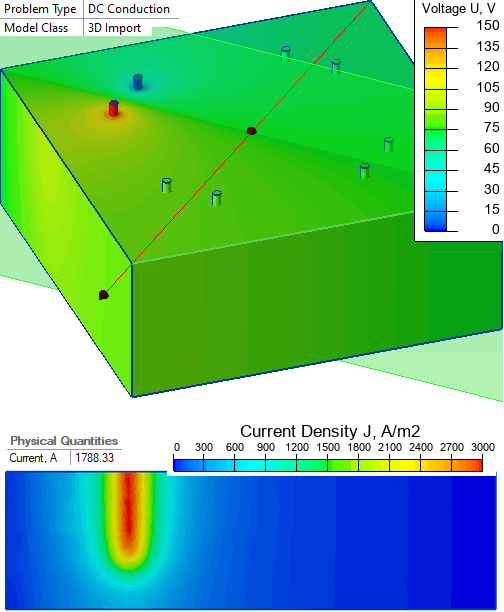
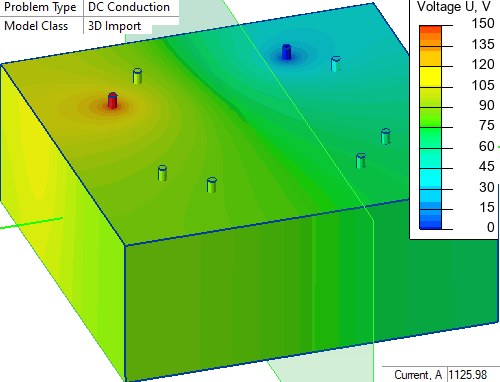
The electric glass melter features 8 electrodes deeply inserted into the bulk glass [1]. We need to find the electrode to electrode resistances.
How to calculate electrode-to-electrode resistance matrix?
Answer Typical applications Geometry
Given
Task
Solution
Results
Reference:
Engineering question
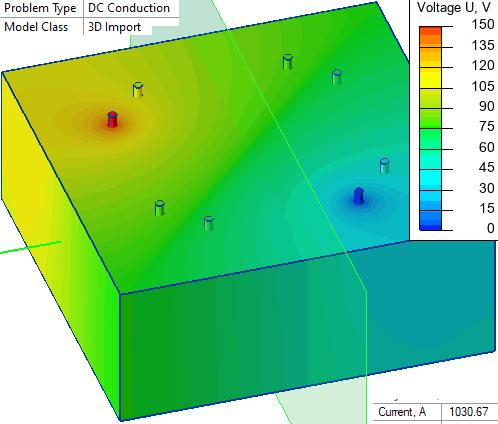
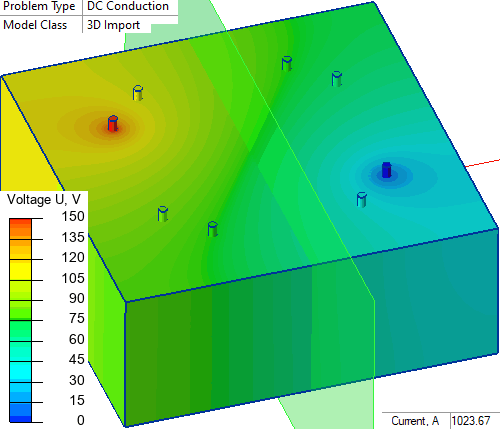
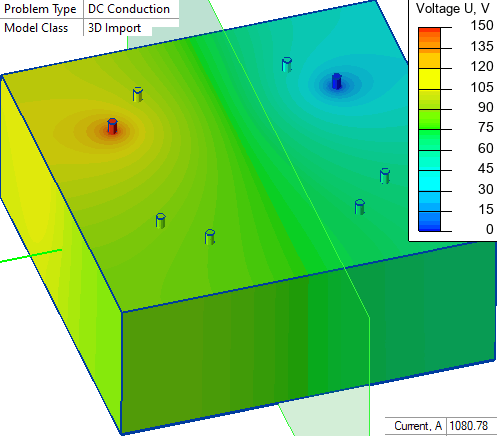
We should apply the electric potential difference to each pair of electrodes and measure the current.
glass melting furnaces, molten glass electrodes, furnace electrode arrays
Download
Simulation problem
Problem Type
3D problem of DC conduction.
Geometry model is prepared by Ivan De Luca (I.E.C.I. Engineering srl.)
Electrical conductivity of electrodes 3.17 MS/m,
Electrical conductivity of glass 11 S/m.
Calculate electrode-to-electrode resistance matrix.
We should apply the electric potential difference to each pair of electrodes and measure the current. The resistance is the ratio of potential difference to this current.
There are
combinations of pairs of electrodes. Due to model symmetry there is no need to calculate all inter-electrode resistances:
R12 = R34 = R56 = R78
R13 = R24 = R57 = R68
R14 = R23 = R58 = R67
R15 = R27 = R36 = R48
R16 = R17 = R25 = R28 = R35 = R38 = R46 = R47
R18 = R26 = R37 = R45
Electrode potential Current, A Resistance, mOhm
#1 #2 #3 #4 #5 #6 #7 #8
150 0 1788 83.9
150 0 1030 145.6
150 0 1023 146.6
150 0 1080 138.9
150 0 1126 133.2
150 0 1126 133.2
150 0 1217 123.3

[1] A.A. Ghandakly; R.L. Curran Accurate modeling of interelectrode resistance and power dissipation in electric glass melters IEEE Transactions on Industry Applications (Volume: 24, Issue: 6, Nov.-Dec. 1988).