Slot embedded conductor - QuickField simulation example
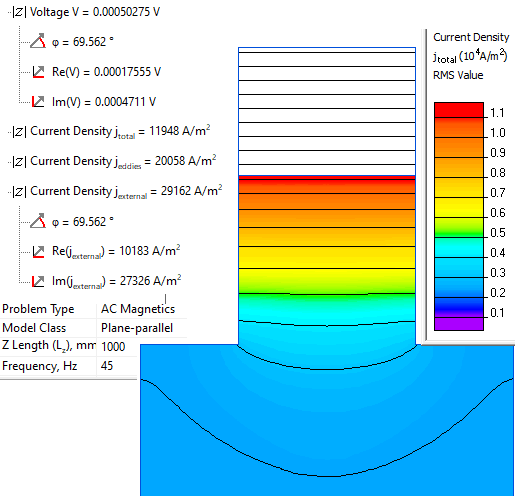
This is an example of the slot embedded conductor simulation, performed with QuickField software. A solid copper conductor embedded in the slot of an electric machine carries a current I at a frequency f.
How to find current distribution and impedance in slot-embedded conductors?
Answer Typical applications Geometry
Given
Task
Solution
The complex impedance per unit length of the conductor can be obtained from the equation Z = V / I, where V is a voltage drop per unit length.
Results
Impedance Z = 0.000175 + j0.000471 Ohm/m
*Reference: A. Konrad, Integrodifferential Finite Element Formulation of Two-Dimensional
Steady-State Skin Effect Problems, IEEE Trans. Magnetics, Vol MAG-18, No. 1, January 1982.
Engineering question
Solve the AC-magnetic slot model with the appropriate magnetic boundary conditions, calculate current density in the conductor, and obtain complex impedance from the voltage drop divided by current.
slot-embedded conductors, stator slot windings, embedded machine conductors
Download
Simulation problem
Problem Type
Plane-parallel problem of AC magnetics.
Conductivity of copper σ = 58,005,000 S/m;
Current in the conductor I = 1 A;
Frequency f = 45 Hz.
Determine current distribution within the conductor and complex impedance of the conductor.
We assume that the steel slot is infinitely permeable and may be replaced with a Neumann boundary condition (zero tangential field). We also assume that the flux is contained within the slot, so we can put a Dirichlet boundary condition (A=const) along the top of the slot.
Current density in slot embedded conductor:
External current density, A/m²
QuickField
10183 + j27326
Reference*
10182.7 + j27327.9
Video
Related examples