Hot water radiator - QuickField simulation example
In this example, we calculate the temperature distribution and heat power of a domestic hot water radiator.
How to find temperature distribution and heating power of hot water radiators?
Answer Typical applications Geometry
Given
Task
Solution
We do not model water fluid dynamics nor the air gas dynamics. Instead, we specify an average value of the convection coefficient at the corresponding radiator surfaces.
Results
Engineering question
Set up a 3D QuickField Steady-state Heat Transfer problem for a hot water radiator and evaluate temperature distribution and heating power from computed field results.
hot water radiators, hydronic heating radiators, domestic heating emitters
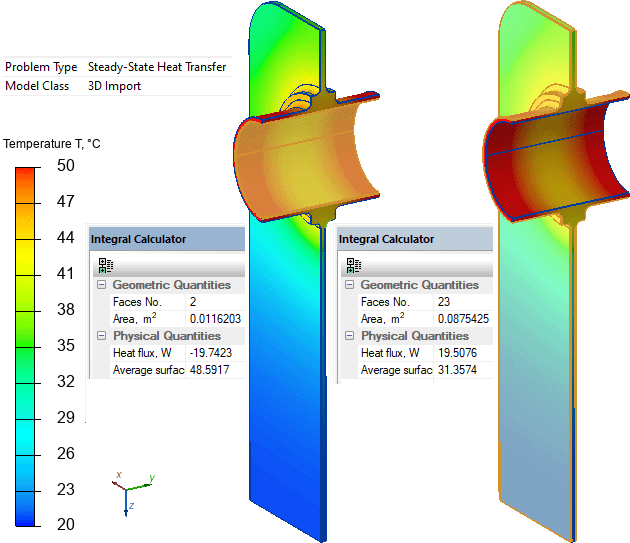
Download
Simulation problem
Problem Type
3D problem of heat transfer.
Thermal conductivity of steel λ = 40 W/K-m.
Ambient air temperature +20 °C, convection coefficient 10 W/(K·m²).
Hot water temperature +60 °C, convection coefficient 150 W/(K·m²).
Calculate the radiator's heat power.
We model only a single section. The geometry model features symmetry so we model only a quarter of the section. Remember to take this into account when calculating the total heat flux.
We can measure the heat flux either at the air side or at the water side. In fact, both values should be the same. Any difference will indicate a calculation error.
The section heat flux is 4*19.5 = 78 W.
Heat flux
Water side 19.74 W
Air side 19.50 W
Difference 0.24 W
Error 1.2%
Related examples