Induction motor analysis - QuickField simulation example
This is a simulation example from Compumag TEAM Workshop Problem 30*.
How to calculate induction-motor torque and rotor losses and compare with benchmark data?
Answer Typical applications Geometry
Given
Task
Solution
It is not possible to specify the negative frequency in the problem. Instead we specify |fslip|, but consider the calculated torque value to be negative.
Results
Reference
Engineering question
Use the slip frequency in the AC-magnetic model to calculate torque and steel and aluminium rotor losses at the specified operating point.
TEAM benchmark induction motors, rotating field motors, induction motor test cases
Download
Simulation problem
Problem Type
Plane-parallel problem of AC magnetics.
Current density in a coil j = 310 A/cm² (r.m.s)
Frequency f = 60 Hz.
Aluminum conductivity 37.2 MS/m.
Relative permeability of steel μr=30.
Rotor steel conductivity 1.6 MS/m.
Stator steel is laminated and has a zero conductivity.
Calculate the torque, rotor steel and aluminum Joule heat losses and compare the results with a reference value.
To simulate the motion we will attenuate the AC problem frequency: fslip = slip * f,
where slip = 1 - (rotor angular frequency / synchronous angular frequency).
Synchronous angular frequency is 2πf = 2*3.142*60 = 377 rad/s.
Rotor
angular
frequency,
rad/s
Slip
Frequency fslip, Hz
0 1 60
200 0.469 28.2
400 -0.061 -3.66
600 -0.592 -35.5
800 -1.122 -67.3
1000 -1.653 -99.2
1200 -2.183 -131
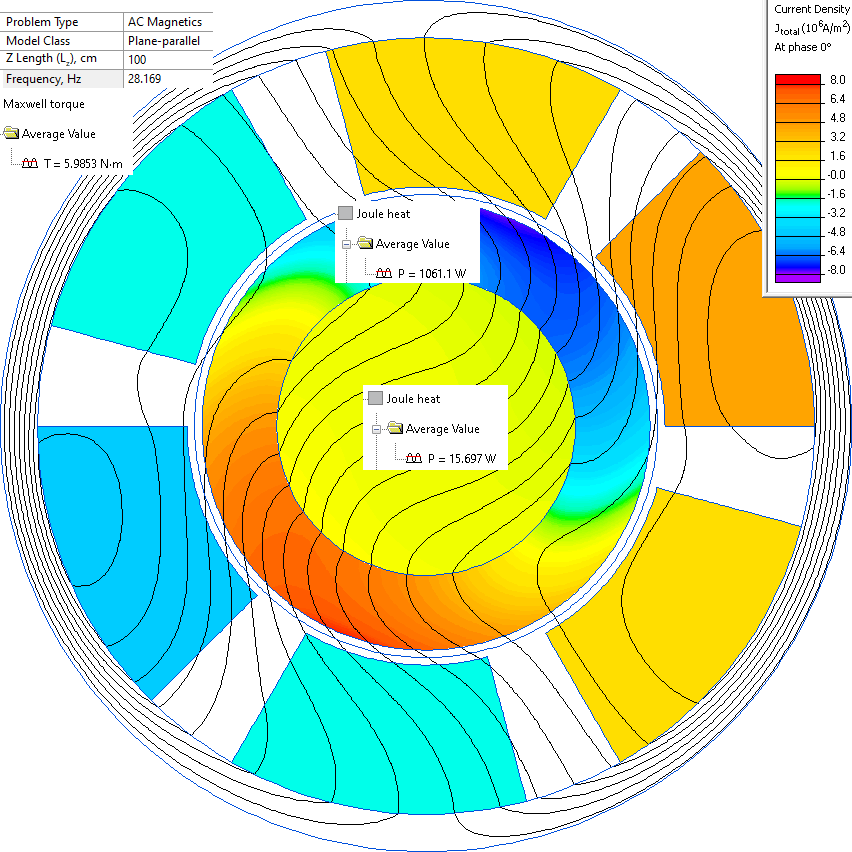
Eddy current distribution at 28.2 Hz (equivalent to rotor angular frequency of 200 rad/s). Torque is 6 N*m, rotor steel losses are 15.7 W, rotor aluminum losses are 1061 W.
*Compumag TEAM Workshop
Related examples