ISO 10077-2:2012 Test case D.8 - Roller shutter box - QuickField simulation example
QuickField simulation of the test case "D.8. Roller shutter box" presented in ISO 10077-2:2012*
How to calculate 2D thermal conductance for ISO 10077-2 test case D.8?
Answer Typical applications Geometry
Given
Task
Solution
Thermal conductivities of air gaps are adjusted to include the convection and radiation heat transfers in real situation, and correlated with the actual temperatures on the gap contours according to the recommendation of ISO 10077-2:2012. Equivalent air gap conductivity calculations are automated in the accompanying Excel spreadsheet.
Results
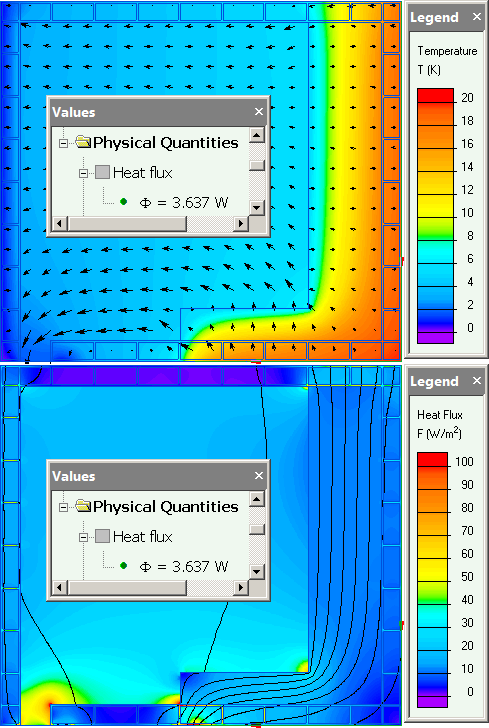
Two-dimensional thermal conductance L2D = Heat flux per meter depth / Temperature difference = 3.64 / 20 = 0.182 W/(m*K).
Reference:
Engineering question
Solve the 2D steady-state heat-transfer model using ISO 10077-2 data; equivalent air-gap conductivity calculation is automated using the accompanying Excel spreadsheet.
roller shutter boxes, shutter housing enclosures, window shutter assemblies
Download
Simulation problem
Problem Type
Plane-parallel problem of heat transfer.
total width b = 177 mm
Thermal conductivity of insulation panel, λ1 = 0.035 W/K-m.
Thermal conductivity of PVC λ2 = 0.17 W/K-m.
Calculate two-dimensional thermal conductance L2D in accordance with ISO 10077-2:2012*.
(Reference thermal conductance L2D = 0.181 W/(m*K) )
Air contact surface thermal resistance Rs is caused by convention mechanism of heat transfer (contrary to conductivity mechanism in case of two solid bodies in contact).
The convection coefficient value is reciprocal to the surface resistance value:
α20 = 1/0.13 W/(K·m²),
α0 = 1/0.04 W/(K·m²).
Heat flux and temperature distribution in frame section profile:
Difference between the calculated and reference values is less than 3%. This simulation accuracy complies with the requirements of ISO 10077-2:2012.
* ISO 10077-2:2012 Thermal performance of windows, doors and shutters -- Calculation of thermal transmittance -- Part 2: Numerical method for frames.
Video
.
Related examples