ISO 10211:2007 Thermal bridges in building construction. Test case A.2 validation - QuickField simulation example
QuickField validation of the test case A.2 presented in ISO 10211:2007 Thermal bridges in building construction.
Engineering question
How to calculate the heat flux and temperature distribution at the thermal bridge where a concrete slab is insulated from a metal beam (ISO 10211:2007 case A.2)?
Answer Set up a plane-parallel QuickField Steady-state Heat Transfer problem for half of the symmetric slab/insulation/beam assembly (using symmetry as recommended by the ISO standard) with proper convection boundary conditions. Read off the heat flux and corner temperatures from the resulting field solution.
Problem Type Plane-parallel problem of heat transfer.
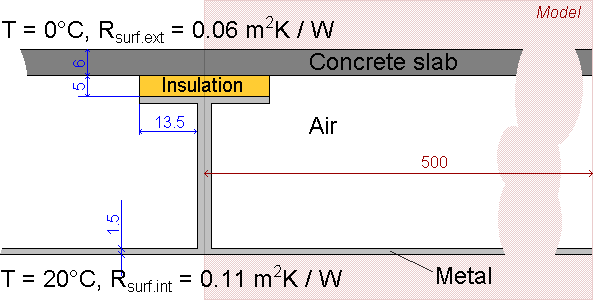
Geometry
Given Thermal conductivity of materials:
concrete slab - 1.15 W/K*m,
insulation - 0.12 W/K*m,
air - 0.029 W/K*m,
metal - 230 W/K*m.
Task The concrete slab is insulated from the metal beam by the insulation layer. Determine the flux and the temperature distribution in the reference points (every corner).
Solution Only half of the model is presented due to symmetry (as recommended in the ISO standard). Air contact surface thermal resistance Rs is caused by the convection.
The convection coefficient value is reciprocal to the surface resistance value:
αsurf.ext = 1/0.06 W/(K·m²),
αsurf.int = 1/0.11 W/(K·m²).
Results Temperature distribution in media:
Heat flux:
Bottom (in)
9.4968 W
Top (out)
9.4937 W
Theory
9.5 W
Temperature calculated in QuickField is presented in the table below (reference temperatures are in the brackets). To comply with the ISO 10211:2007 the difference between calculated and reference temperature should be less than 0.1°K. This simulation accuracy complies with the requirements of ISO 10211:2007.