Magnetic field of a magnetron sputtering system - QuickField simulation example
Magnetic field distribution and field balance in a magnetron sputtering system, evaluating how the magnet arrangement confines electrons near the target.
How to find magnetron sputtering magnetic field balance?
Answer Typical applications Geometry
Given
Task
Solution
Results
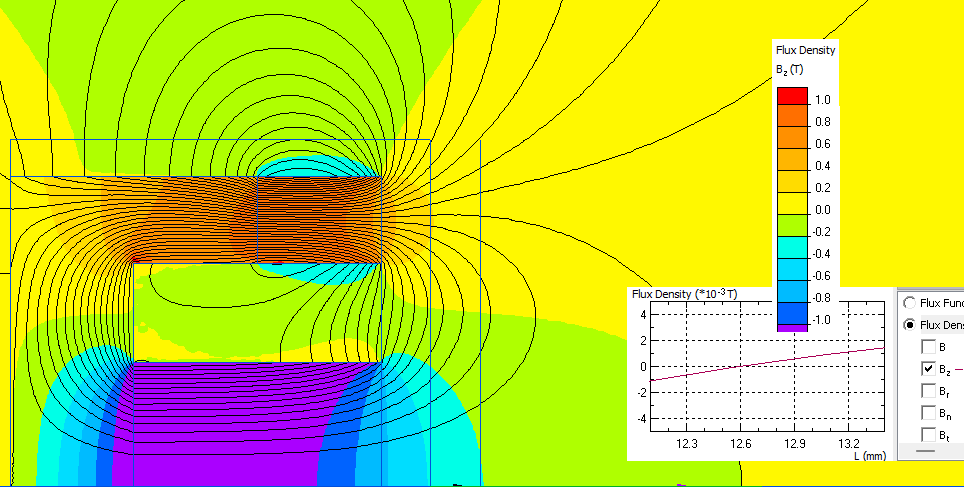
Flux density distribution along the target surface.
References:
Engineering question
Calculate the magnetic field distribution and evaluate the field unbalance using the position where the axial flux-density component changes sign.
magnetron sputtering sources, plasma sputtering targets, sputtering magnet assemblies
Download
Simulation problem
Problem Type
Plane-parallel problem of DC magnetics.
Permanent magnets are made of NdFeB N42, coercive force is 860 kA/m, relative permeability is 1.2.
Core relative permeability is 1000.
Calculate the magnetic field distribution and measure the magnetic field unbalance.
We use the unbalance coefficient proposed by Gencoa Ltd*. The coefficient is calculated as g = ZBz=0 / W½, where ZBz=0 is the distance from target to the point, where magnetic flux z-component is zero, and W½ is the target radius.
ZBz=0 = 12.6 mm. Unbalance coefficient g = 12.6 / 14 = 0.9.
* R. Brown, V. Bellido-Gonzalez. Comparison of balanced and unbalanced array designs., Thin film and PV solution, 2013.
Related examples