Periodic Boundary Condition - QuickField simulation example
This very simple example demonstrates the effect of applying periodic boundary condition, which forces the field potential to be the same on opposite sides of the model.
How to calculate the effect of periodic and odd-periodic boundary conditions on a repeating magnetic-field model?
Answer Typical applications Geometry
Given
Results
Engineering question
Use equal-potential periodic boundaries for repeating regions or opposite-potential odd-periodic boundaries, without requiring identical meshes on paired sides.
electric machine sectors, repeating magnetic structures, periodic motor geometries
Download
Simulation problem
Problem Type
Plane-parallel problem of DC magnetics.
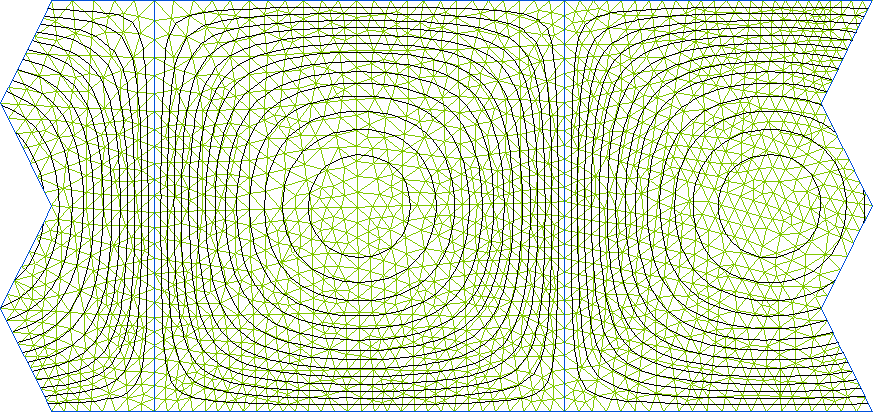
Two regions, A and B, have the same shape, current loading and are surrounded by Dirichlet boundary condition, which does not allow the field to penetrate outside. Region B is also subdivided into B1 and B2, and the periodic boundary condition is specified on two sides, which makes these regions the continuation of each other. As a result, field distribution in both A and B must be equivalent.
This example also demonstrates that the mesh on the periodic boundary is not necessarily the same - please notice that the mesh spacing settings in four corners of the model are all different!
There are 2 problems Perio1.pbm and Perio1odd.pbm in the archive. Perio1odd.pbm is almost the same, but for one difference: odd periodic condition is applied, which forces the field potential to be opposite on two sides of the region.
Related examples