Underground cable crossing - QuickField simulation example
There are two single-phase cables crossing underground at different levels. Similar cable construction simulated in High voltage cable ampacity example.
How to find temperature profile of crossing underground power cables?
Answer Typical applications Geometry
Given
Task Solution
Results
Engineering question
Apply conductor and shield losses as volumetric heat sources in the 3D crossing-cable model and solve for the soil temperature profile and cable conductor temperatures.
crossing underground cables, buried cable intersections, underground cable corridors
Download
Simulation problem
Problem Type
3D problem of heat transfer.
Rated current: 1 kA
Aluminum conductor Joule heating power: 21.4 W per 1 meter of length.
Copper shield Joule heating power: 24.5 W per 1 meter of length.
Thermal conductivity of soil: 0.63 W/(m·K);
Thermal conductivity of aluminum: 200 W/(m·K);
Thermal conductivity of copper: 380 W/(m·K);
Ambient air: temperature T = 20°C, convection coefficient 10 W/K-m²,
Calculate the temperature profile in the soil and cable conductor temperature.
In QuickField we specify the volume power density, which is Joule heating power per 1 meter of length [W/m] divided by the conductor cross-section area [m²].
The geometry model features symmetry, which allows reducing simulation domain.
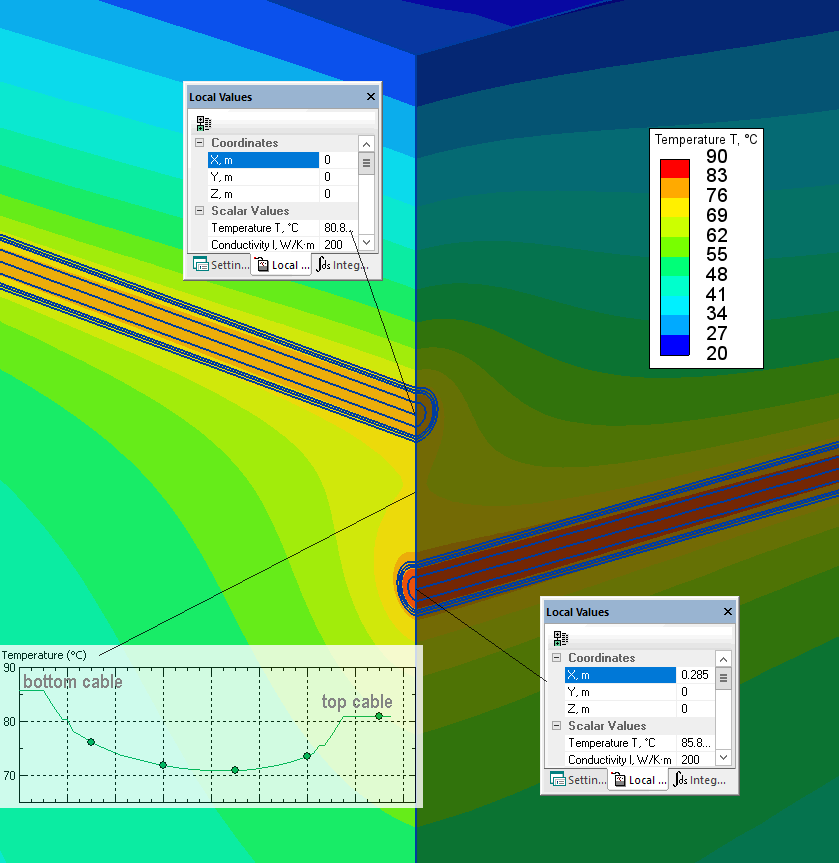
Temperature distribution in the soil and cables. Upper cable conductor temperature is 81°C. Bottom cable conductor temperature is 86°C.
Related examples