Advanced Magnetics--Step-by-Step Description: Step 11
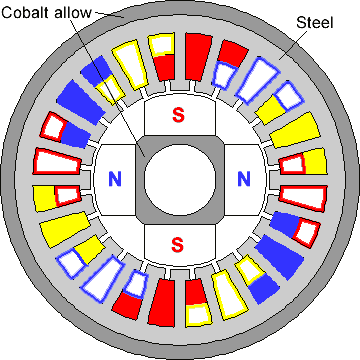
Now we can assign labels to geometrical objects to describe material properties, sources and boundary conditions.
The problem contains five materials: the air, the steel, the frame's Cobalt-Nickel-Copper-Iron alloy, Samarium-Cobalt magnets and coils. We'll use the labels Air, Steel, Cobalt Alloy, and Magnet. Since the components of coercive force for each magnet would change, it is easier to define the permanent magnets by equivalent surface currents applied to the side edges of each magnet. In our case this approach is not exact, since it ignores coercive force in a thin curved part of each magnet. But explicit experiment shows that two approaches give very close results, so we can use the more convenient one.
Coils are loaded through a three-phase set up, with each phase having into and out of plane directions. We will use labels: Coil R+, Coil R-, Coil S+, Coil S-, Coil T+, and Coil T-.
To assign labels to blocks:
-
Double-click inside the steel section. The whole steel block surrounding all the 24 coil slots becomes selected and the Properties dialog box appears.
-
In Label area, type Steel and click OK.
-
Select the two air regions (the air gap between the rotor and stator and the air inside the inner frame), and label them as Air. Remember that simple clicking the object clears the previous selection, while clicking with the CTRL held down appends current object to the selection.
-
Next, select the inner and outer frames and type in the corresponding label Cobalt Alloy.
-
Select all the coil blocks that belong to R+ group. If you have selected an excess block, pick it once more to unselect it.
-
Label selected blocks as Coil R+.
-
Repeat the above process to label the rest of the coil slots according to the model's figure as Coil R-, Coil S+, Coil S-, Coil T+, Coil T-.
-
Next, assign Magnet label to all the four permanent magnet pieces.