Temperature distribution in an electric wire - QuickField simulation example
Calculate the temperature distribution in a long current carrying wire.
How to find temperature in current-carrying wires?
Answer Typical applications Geometry
Given
Task Solution Results
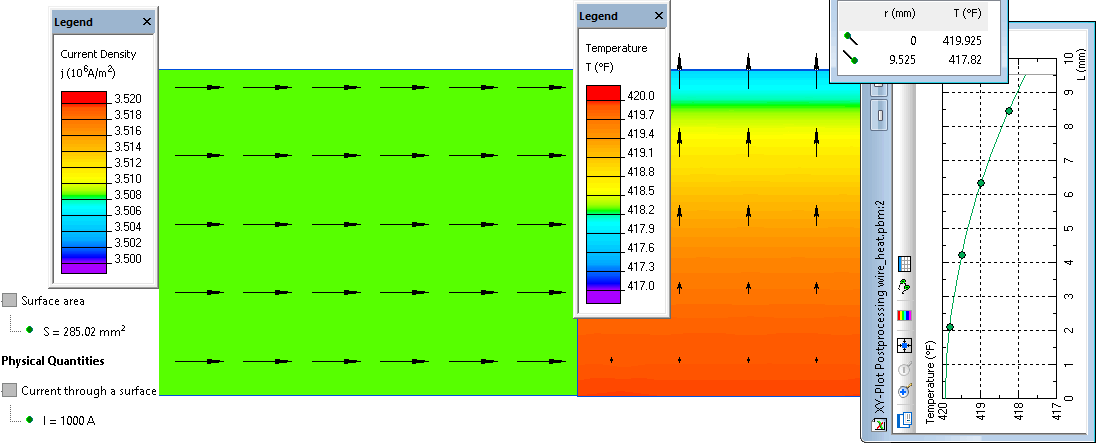
Electric current density and temperature distribution in an electric wire:
*Reference: W. Rohsenow and H. Y. Choi, "Heat, Mass, and Momentum Transfer", Prentice-Hall, N.J., 1963.
Engineering question
Set up an axisymmetric QuickField Multiphysics problem for a current-carrying wire and evaluate temperature rise from computed field results.
current-carrying wires, fuse wires, electrical conductors
Download
Simulation problem
Problem Type
Axisymmetric multiphysics problem of DC Conduction coupled to Heat Transfer.
Wire diameter d = 0.75";
Resistance ρ = 9.35·10-8 Ohm/m;
Electric current I = 1000 A;
Thermal conductivity λ = 13 Btu·ft/(h·ft²·°F) = 22.5 W/(K·m);
Convection coefficient α = 5 Btu/(h·ft²°F) = 28.4 W/(K·m²);
Ambient temperature To = 70°F = 21.1°C.
Calculate the temperature distribution in the wire.
We arbitrary chose a 1-foot (12") piece of wire to be represented by the model.
Material electric conductivity is σ = 1/ρ = 1/9.35e-8 = 10.7·106 S·m.
For the conduction problem we specify normal current density at one end j = I /(πd²/4) [A/m²] and zero voltage at another end of the wire, and a zero current condition at its surface.
For heat transfer problem we specify zero thermal flux conditions at the sections of the wire and a convection boundary condition at its surface.
Reference*
QuickField
Center line temperature
419.9°F
419.9°F
Surface temperature
417.9°F
417.8°F
Video
Related examples