Double wound solenoid inductance - QuickField simulation example
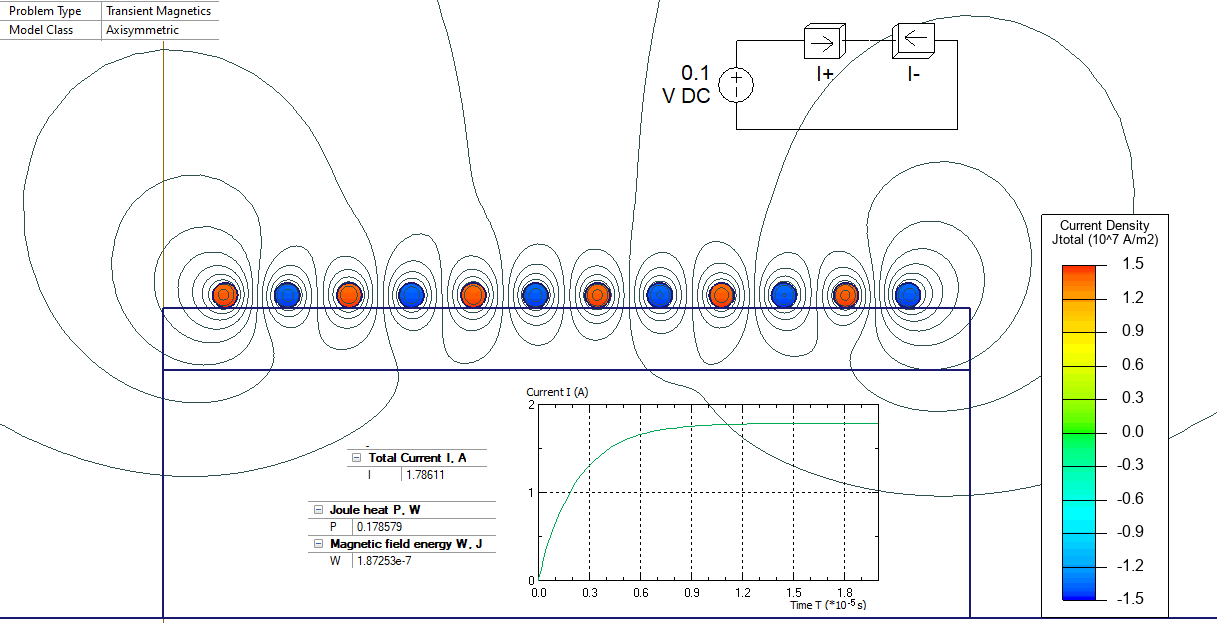
DC voltage is applied to the low inductance solenoid with double winding. Transient process of electric current vs. time is analyzed.
How to calculate the inductance, resistance, and steady-state temperature of a double-wound solenoid?
Answer Typical applications Geometry
Given
Task
Solution
Result
Magnetic field energy W = 0.187 μJ, inductance L = 2* 0.187 / 1.786² = 0.117 uH.
Solenoid time constant L/R = 0.117 / 0.056 = 2.09 us.
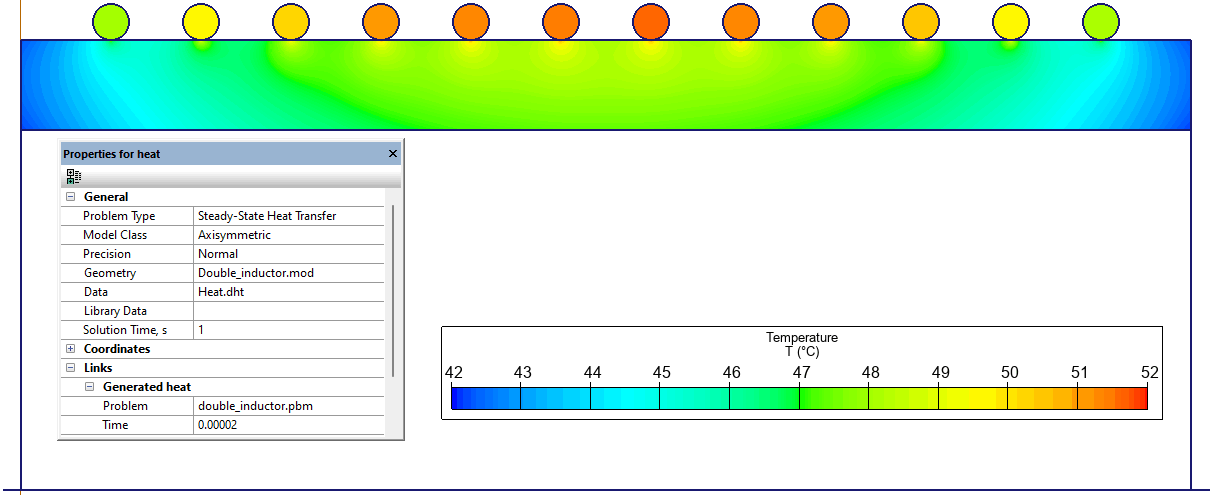
Steady-state temperature of the coil is 50°C.
Engineering question
Set up an axisymmetric QuickField Transient Magnetics problem coupled to Heat Transfer and connect the winding to an external electric circuit. Compute resistance and inductance from the field results, and read the steady-state coil temperature from the coupled thermal solution.
dual-winding solenoids, sensor excitation coils, electromagnetic actuator coils
Download
Simulation problem
Problem Type
Axisymmetric multiphysics problem of Transient magnetics coupled to Heat Transfer.
Conductor diameter 0.4 mm.
Copper electric conductivity σ = 56 MS/m.
Voltage U = 0.1 V.
Ambient air temperature T0 = 20°C, convection coefficient average value α = 5 W/K-m².
DC voltage is applied to the coil. Calculate the inductance, resistance and steady-state temperature.
Transient magnetic formulation in QuickField allows assign electric conductivity to blocks and connect blocks using the external electric circuit. The coil resistance can be calculated using circuit-simulation results: R = V / I.
The coil inductance can be calculated using the field simulation results: L = 2*Energy / I ².
The coil temperature is calculated in a heat transfer problem that is linked to the transient magnetics problem.
Double wound solenoid current I = 1.786 A, Joule heat P = 0.1786 W. Resistance R = 0.1 / 1.786 = 0.056 Ohm.
Video
Related examples