Einzel lens - QuickField simulation example
Engineering question
How to calculate the focal length of an electrostatic Einzel lens?
Answer
Launch a charged particle parallel to the optical axis at a small radial offset, trace its trajectory through the QuickField electrostatic field with Particle Tracer, and measure the axial distance from the lens center to the point where the trajectory crosses the axis; that distance is the focal length for the given ion energy and electrode voltage.
Typical applications
ion-optical beamlines, electron/ion microscopes, mass spectrometers, particle accelerator injectors
Download
- Download simulation files (files may be viewed using any QuickField Edition).
Simulation problem
Axisymmetric problem of electrostatics, with particle motion evaluated by the Particle Tracer.
Geometry
Given
Electric potential difference ΔU = 1000 V.
A singly charged argon-40 ion has charge q = e ≈ +1.602176634e-19 C and mass m ≈ 39.948 unified atomic mass units ≈ 6.6335e-26 kg.
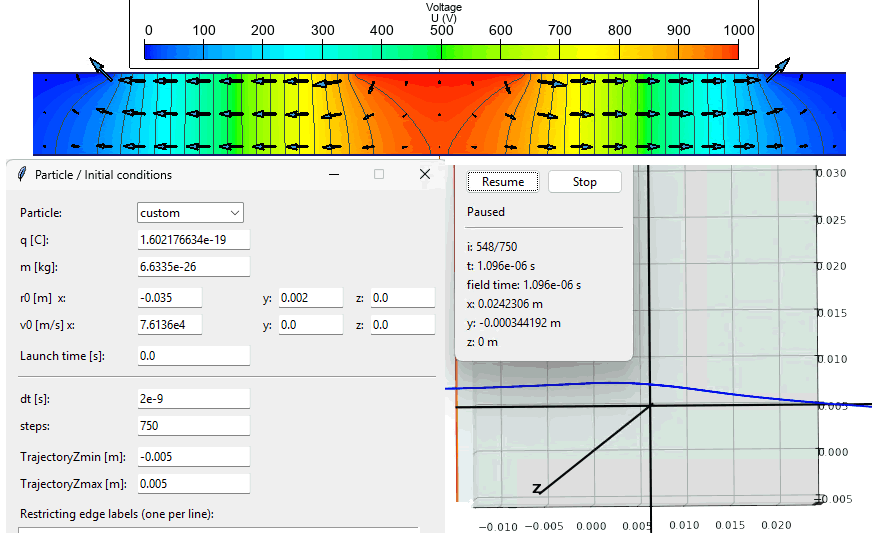
Ion initial position and speed: (x0, y0, z0) = (-35, 2, 0) mm, v0 = (7.6136e4, 0, 0) m/s (≈1.2 keV).
Task
Calculate the Ar+ ion trajectory through the Einzel lens and verify that the beam is focused without being reflected by the +1000 V central electrode.
Solution
QuickField computes the non-uniform axisymmetric electrostatic field of the three-electrode lens.
The QuickField Particle Tracer reconstructs the axial and radial field components as a three-dimensional Cartesian field around the X axis and numerically integrates the equation of motion m·d²r/dt² = q·E(r) for 750 steps of 2e-9 s.
Results
The ion slows down while climbing the +1000 V barrier near the central electrode, then recovers speed on exit. The trajectory bends outward on entry and inward on exit, crossing the axis downstream of the lens.
The focal length, measured from the lens center at x = 0, is f ≈ 20.15 mm for this ≈1.2 keV Ar+ ion and 2 mm entry offset.
The ion remains inside the 5 mm aperture throughout, stays in the meridional plane (z = 0), and recovers its initial kinetic energy after leaving the field-free region beyond x = 40 mm, as expected for a conservative electrostatic field with equal entry and exit potential.
| Quantity | Analytical (entry) | QuickField (exit, calculated) |
| Speed, km/s | 76.136 | 76.132 |
| Kinetic energy, eV | 1200.003 | 1199.880 |
References:
https://en.wikipedia.org/wiki/Einzel_lens