Equivalent airgap - QuickField simulation example
Engineering question
How to calculate Carter coefficient?
Answer
The Carter coefficient for a slotted magnetic air gap, obtained from the ratio of fundamental air-gap flux density for slotted and smooth-gap configurations.* We are going to fill slots with steel to get a smooth air gap.
Typical applications
slotted electrical machine airgaps, rotating machine airgaps, stator-rotor magnetic gaps
Download
- Download simulation files (files may be viewed using any QuickField Edition).
Simulation problem
Problem TypePlane-parallel problem of DC magnetics.
Geometry
Given
Stator slots number Z1 = 48
Rotor slots number Z2 = 36
Number of phases m=3
Number of poles 2p=4
The B-H curve for the stator and the rotor:
Task
Calculate Carter coefficient.
Solution
The Carter coefficient for a slotted magnetic air gap, obtained from the ratio of fundamental air-gap flux density for slotted and smooth-gap configurations.*
We are going to fill slots with steel to get a smooth air gap. In this case there will be no place for the winding. We replace real winding with the current layer placed in the air gap. The same current layer is used for the slotted configuration:
Ht(phi) = 30000 * cos(p * phi) [A/m], where p=2 is a pole's pairs.
We are not interested in induced voltages and eddy currents so the analysis is carried on using the DC Magnetic formulation.
QuickField built-in Harmonic browser add-in is used to calculate the flux density fundamental harmonic amplitude.
Results
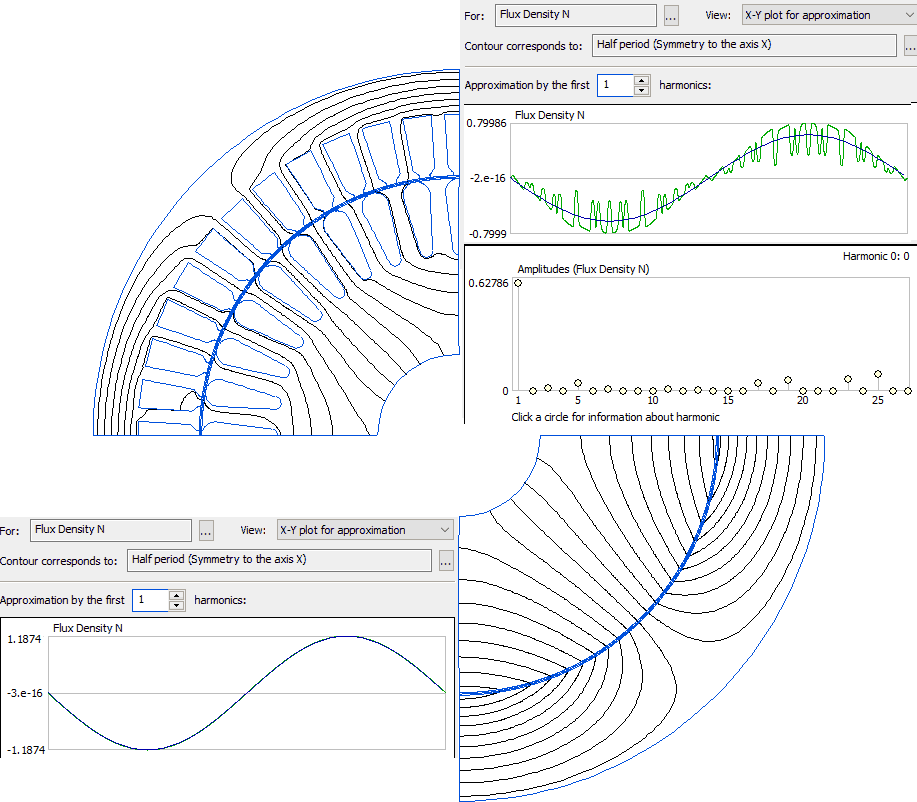
Airgap flux density fundamental harmonic is 1.18T for smooth stator and 0.80T for slotted stator.
Carter coefficient = 1.18 / 0.80 = 1.47
Field picture of the flux density distribution and the fundamental harmonic magnitude.
Reference
* Ion Boldea, Syed A. Nasar. The Induction Machines Design Handbook, p.88.