Inductive sensor - QuickField simulation example
Output voltage of an inductive position sensor versus air-gap size, based on the change of coil inductance as the sensor components move relative to each other..
How to find the output voltage of an inductive sensor as a function of the air gap?
Answer Typical applications Geometry
Given
Task
Solution
Result
Engineering question
Couple the AC-magnetic sensor model to its load circuit, sweep the rotor position with LabelMover, and record the load-resistor voltage for each air-gap size.
inductive position sensors, variable inductance sensors, displacement sensing coils
Download
Simulation problem
Problem Type
Plane-parallel problem of AC magnetics.
The number of turns in the coil N = 210
AC voltage frequency f = 400 Hz
Source voltage U = 24 V (root mean square)
Load resistor R = 1 Ohm
Air gap 0.1 - 0.6 mm.
Calculate the voltage across the load resistor of the sensor as a function of the air gap size.
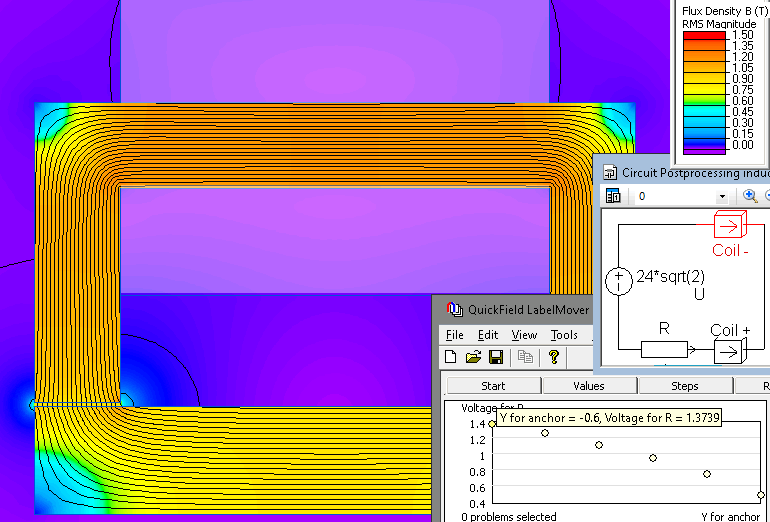
When the position of the rotor changes, the inductance of the coil changes. The joint simulation of the magnetic field and the electric circuit is performed.
In the electric circuit, the amplitude value of the source voltage must be specified, i.e. U * sqrt (2).
To automate the calculations, the LabelMover add-in is used, which moves the rotor by 0.1 mm increments, solves the problem and measures the voltage drop across the load resistor.
Magnetic flux density distribution in the core, electrical circuit with load resistor and output voltage for various air gap sizes.
Related examples