Inkjet droplet deflection - QuickField simulation example
Engineering question
How to calculate the trajectory of a charged inkjet droplet between deflection plates?
Answer
Calculate the electrostatic field between the deflection plates and use the QuickField Particle Tracer utility to obtain the charged droplet trajectory and deflection.
Typical applications
continuous inkjet (CIJ) printing, droplet sorting, electrostatic beam steering
Download
- Download simulation files (files may be viewed using any QuickField Edition).
Simulation problem
Plane-parallel problem of electrostatics, with particle motion evaluated by the Particle Tracer.
Geometry
Given
Electric potential difference ΔU = 1000 V.
Charged ink droplet charge q = 1e-13 C, mass m ≈ 6.5e-11 kg (a water-like-density droplet with a radius of about 25 µm).
Droplet initial position and speed: (x0, y0, z0) = (0, 0, 0) mm, v0 = (20, 0, 0) m/s.
Task
Calculate the droplet trajectory through the 20 mm deflection region and compare the numerical result with the analytical parabolic estimate.
Solution
QuickField computes the essentially uniform plane-parallel electrostatic field between the two plates.
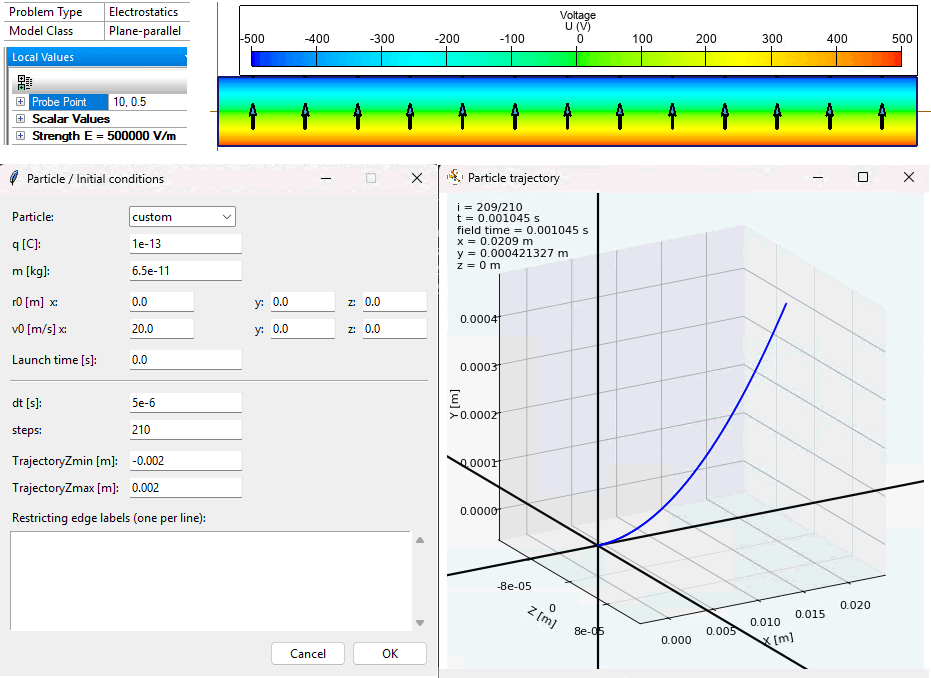
The QuickField Particle Tracer integrates the equation of motion m·d²r/dt² = q·E(r) for 200 steps of 5e-6 s.
Analytical estimate (neglecting drag):
Electric field stress Ey = ΔU / 0.002 = +5.0e5 V/m
The transverse acceleration is
ay = qE/m = (1e-13 C · 5.0e5 V/m) / 6.5e-11 kg ≈ 769.231 m/s².
The continuous parabolic solution is y(x) = 0.5·ay·(x/v0)².
At x = 20 mm and v0 = 20 m/s the transit time is t = x/v0 = 0.001 s
Transverse displacement y(20 mm) = 0.5 · 769.231 · (0.001)² ≈ 3.846e-4 m ≈ 0.385 mm.
Results
The droplet moves at an essentially constant velocity of 20 m/s in the +X direction while accelerating toward the negative electrode.
The trajectory is a smooth upward-opening parabola. It reaches a deflection of y = +0.387 mm after traveling 20 mm. This is well inside the 2 mm electrode gap.
| Quantity | Analytical | QuickField (calculated) |
| X at flight end (t = 1 ms), mm | 20.000 | 20.000 |
| Vy at flight end (t = 1 ms), m/s | 0.769 | 0.769 |
| Deflection y at flight end (t = 1 ms, x = 20 mm), mm | 0.385 | 0.387 |