Liquid level resistive sensor - QuickField simulation example
This simulation example of a resistive liquid level sensor is prepared by Dieter Stotz as a part of the webinar Level measurement on liquids, part 1.
How to calculate the vessel potential of a resistive liquid-level sensor as a function of liquid height?
Answer Typical applications Geometry
Given
Task
Solution
Results
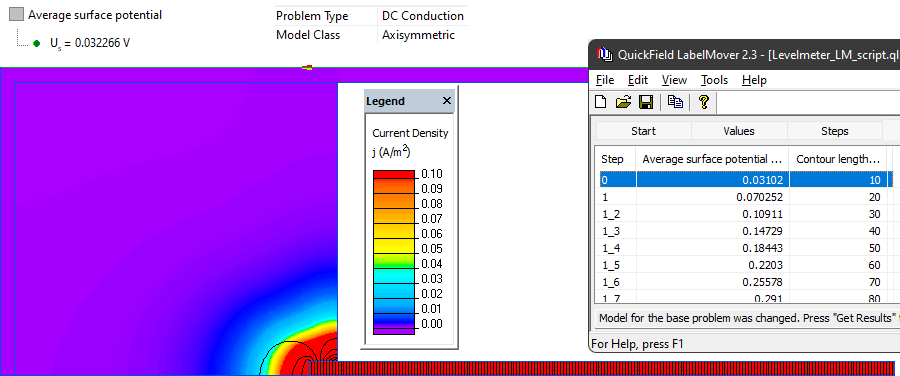
Current density distribution in the liquid.
Engineering question
Use an axisymmetric DC-conduction model and LabelMover to sweep the liquid level and calculate the vessel-potential response.
resistive level sensors, conductive probes, industrial level measurement devices
Download
Simulation problem
Problem Type
Axisymmetric problem of DC conduction.
Electrical conductivity of liquid 0.1 S/m.
Electrode potential difference ΔU = 2 V.
Vessel potential versus liquid height in a resistive level sensor, showing how the conducting liquid level changes the measured electrical potential.
The geometry model features rotational symmetry and can be simulated as a 2D axisymmetric problem. In axisymmetric problems the axis of rotation is a horizontal one.
A series of problems with different liquid levels is generated by LabelMover.
Vessel potential is a nonlinear function of the liquid level.
Related examples