Attraction and repelling of spherical permanent magnets - QuickField simulation example
Comparison of the attraction and repelling forces between two identical spherical permanent magnets at the given air gap.
Is the repelling force between two spherical magnets equal to their attraction force?
Answer Typical applications Geometry
Given
Task
Solution
In QuickField the permanent magnet is specified by its coercive force and relative magnetic permeability. The BH-curve of the magnet is linear, so its relative permeability is
Result
Engineering question
For magnets with relative permeability equal to 1 the forces are equal in magnitude. Real NdFeB magnets have permeability slightly above 1, so the attraction force is slightly larger than the repelling force.
spherical permanent magnets, ball magnet assemblies, magnetic toys, magnetic couplings
Download
Simulation problem
Axisymmetric problem of DC magnetics
Both magnets are of the same size, diameter D = 3/8" (9.525 mm).
Air gap between the magnets δ = 1 mm.
Permanent magnet grade N42 coercive force is Hc = 910 kA/m, Br = 1.32 T.
Compare the attraction and repelling forces between the spherical permanent magnets.
Both magnets are magnetized along the common axis, so the problem can be simulated as a 2D axisymmetric model. One model contains both cases: the attraction and the repelling differ only by the magnetization direction of the second magnet.
μ = Br / (μ0Hc) = 1.32 / (4π·10−7 · 910·103) ≈ 1.15.
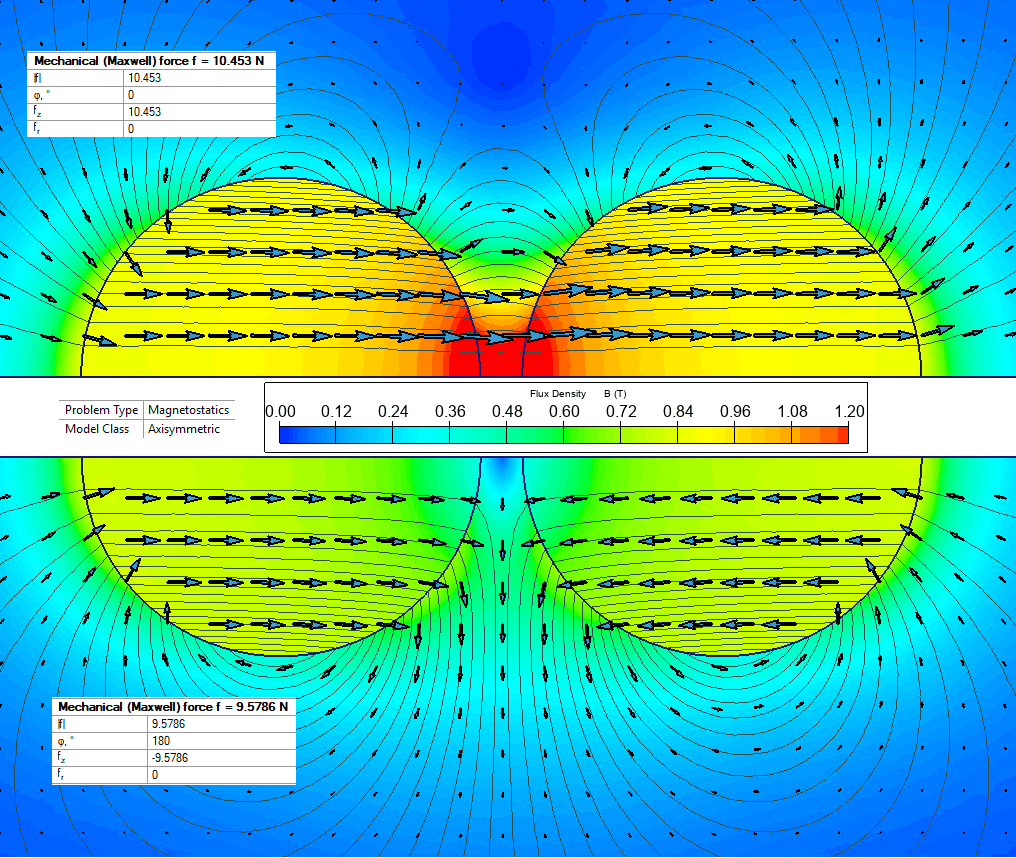
Attraction force: 10.45 N, repelling force: 9.58 N.
Upper half: attraction, both magnets are magnetized in the same direction.
Lower half: repelling, the second magnet is turned over.Related examples