Electrodynamic levitation device - QuickField simulation example
This is a simulation example from Compumag TEAM Workshop Problem 28. We do not simulate transients with motion, instead an AC magnetic problems is simulated to calculate the stable position of the levitating plate.
How to calculate the stationary levitation height of an electrodynamically levitated disc?
Answer Typical applications Geometry
Given
Task
Solution
Results
Engineering question
Set up an axisymmetric QuickField AC Magnetics problem and use the LabelMover parametric tool to find the disc position where the electromagnetic force balances the gravity force.
electrodynamic levitation devices, eddy-current repulsion systems, contactless magnetic suspension
Download
Simulation problem
Problem Type
Axisymmetric problem of AC magnetics.
Current in a coil I = 20 A (magnitude)
Inner coil number of turns w1=960, outer coil number of turns w2=576.
Frequency f = 50 Hz.
Aluminum conductivity 34 MS/m.
Calculate stationary levitation height and compare with reverence value z=11.3 mm. Aluminum disc weight is m=0.107 kg.
The coils have a lot of turns and are wound with an insulated wire, so the current distribution across the coil cross-section is considered to be homogenious. The coil is modelled as a solid block with total ampere-turns specified.
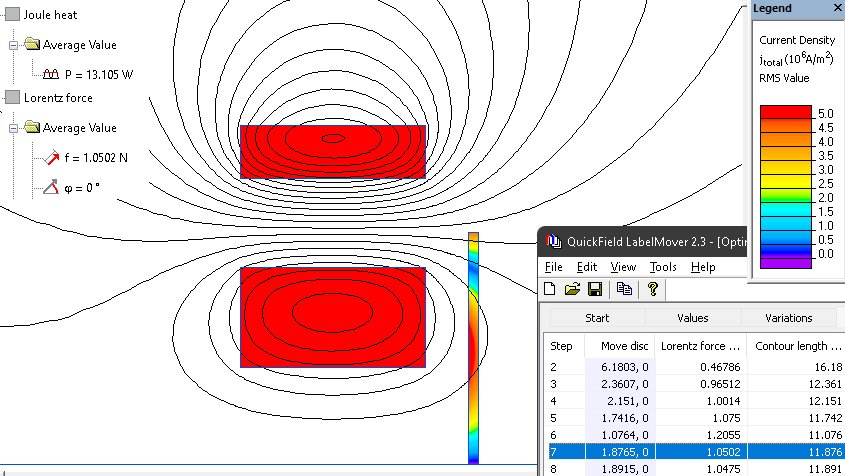
LabelMover parametric tool is used to find the disc position where electromagnetic force is equal to the gravity force m·g = 1.05 H.
QuickField calculated that at z=11.87 mm is the levitation height. Difference between computed and reference values is 5%.
Related examples