Induction heating of the material with temperature dependent properties - QuickField simulation example
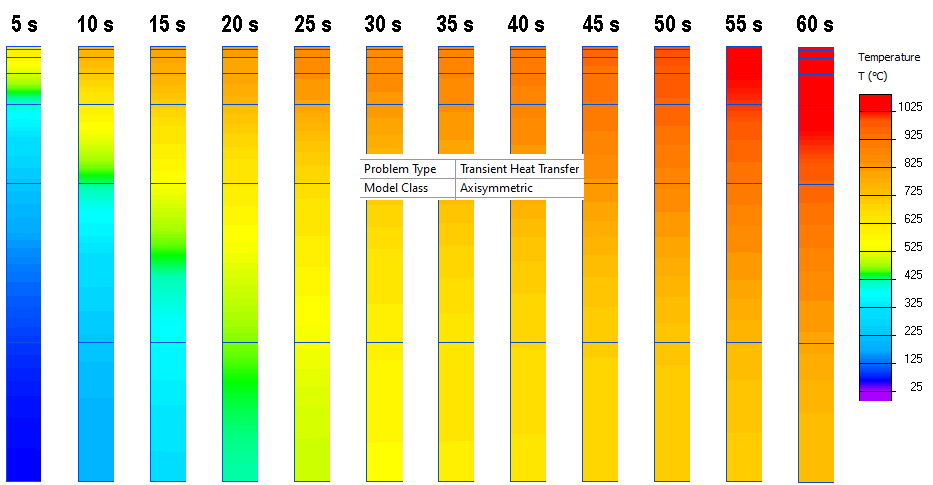
Temperature distribution in a steel billet during induction heating when electrical, magnetic, and thermal material properties vary strongly with temperature.
The general idea, geometry model dimensions and material properties are taken from this paper [1].
Engineering question
How to calculate induction heating when billet properties change with temperature?
Answer Automate staged AC-magnetic and transient heat-transfer analyses, updating the billet's electromagnetic and thermal properties from the temperature reached at each stage.
Given The initial temperature is 25°C.
Coil linear current density is 700 A (r.m.s) per 1 cm of the coil length. Frequency is 8 kHz.
Billet density 7860 kg/m³.
At the temperature above 760°C magnetic permeability is 1.1.
Task Calculate the temperature distribution in the billet during the induction heating process.
Solution We follow the simulation approach laid out in [1], and utilize a specially developed Microsoft Excel VBA script to automate it workflow of the simulation process:
Geometry model is prepared with the billet divided into several zones, to use the B-H curve tables specific to the average temperature of each zone.
AC Magnetic and Transient Heat Transfer problem are created for this geometry model. Simulated time period is very short, to consider material properties not varying significantly during this time interval (later called 'stage').
AC magnetic problem and then Transient Heat Transfer problems are solved, eddy losses distribution is imported to the Transient Heat Transfer problem. Temperature rise over a first time stage is calculated.
Following actions are performed automatically, using Microsoft Excel VBA script:
Temperature distribution at the end of the finished stage is imported into the AC magnetic problem. Internal algorithms of QuickField use electrical conductivities related to the current temperature for any point of the model. The B-H curve data for each zone of the heated billet are generated by the script, basing on the average temperature of the zone.
Using controls of the script, these actions are repeated for the specified number of time stages, or till the specified temperature is reached. All the corresponding AC Magnetic and Transient Heat Transfer problems, which form a chain of time stages, are saved in the separate directory.