Inductively Heated Ceramic - QuickField simulation example
This example is prepared by Didier Werke AG, InduCer Group, Abraham Lincoln Str. 1,65 189 Wiesbaden, Germany
Ceramic nozzle of a Tundish, mounted in the mould wall of a horizontal continuous steel caster, heated by an air-cooled induction coil. Conventional heating (e.g. gas burners) cannot keep steel from freezing in a Tundish nozzle during casting, so the nozzle itself is made electrically conducting and inductively heated - a patented technology (InduCer) developed by Didier Werke AG.
How to calculate impedance and heat-source distribution in inductively heated ceramic?
Answer Typical applications Geometry
Given
Task
Solution
Results
Engineering question
Solve the axisymmetric AC-magnetic problem to obtain electrical impedance and spatial electromagnetic losses, then transfer the losses to transient heat transfer for the ceramic temperature field.
induction-heated ceramics, dielectric ceramic heaters, ceramic processing heaters
Download
Simulation problem
Problem Type
Axisymmetric multiphysics problem of AC magnetics coupled to Transient heat transfer.
Induction current I = 1880 A per turn, frequency f = 10 kHz.
Liquid steel temperature T = 1850°C.
Convection coefficient in the coil cooling channels α = 1200 W/m²K.
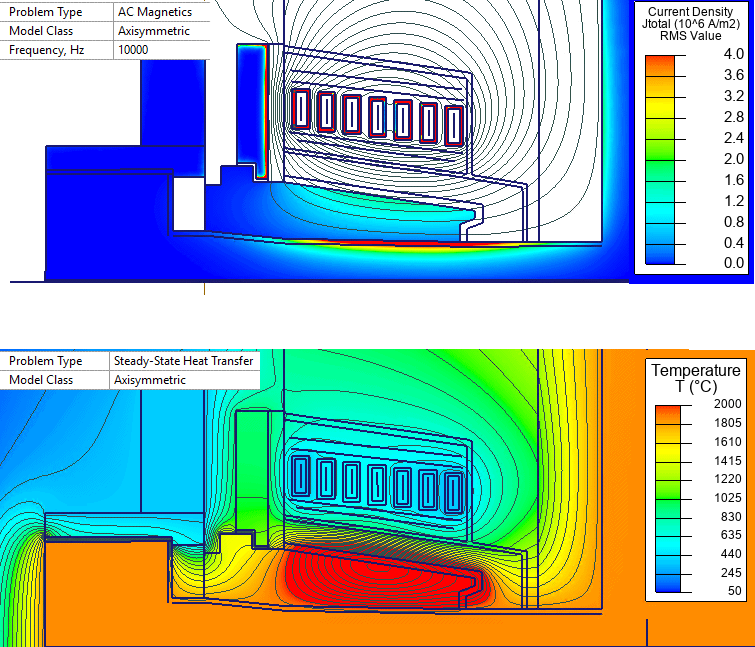
Calculate the coil impedance and spatial heat-source distribution in the inductively heated ceramic nozzle, and use it to find the resulting temperature field.
The problem is solved in two coupled steps: an axisymmetric AC magnetics problem gives the eddy-current losses and the coil impedance. These losses are then applied as a heat source in a transient heat transfer problem.
The copper coil is air-cooled and split into two parallel cooling lines: turns 1-4 and turns 5-7. The air heats up along each line. The convection boundary condition on every turn used its own local air temperature.
More detailed description (in PDF format).
The magnetic field strength |H| reaches about 115 kA/m near the coil turns, and the induced losses (hence the heating) concentrate in the mould and steel parts closest to the winding.
The two coil cooling circuits (turns 1-4 and 5-7) heat the cooling air to about 460 K and 545 K respectively.
Related examples