Mu-metal cylinder shield for the static magnetic field shielding - QuickField simulation example
Static magnetic shielding of a cylindrical mu-metal enclosure for axial and transverse applied fields, comparing shielding effectiveness in both orientations.. Example is prepared by Professor James R. Claycomb as a part of the webinar QuickField for Electromagnetic Shielding Applications.
How to calculate the effectiveness of a cylindrical mu-metal shield for axial and transverse static magnetic fields?
Answer Typical applications Geometry
Given
Problem: Solution
Results
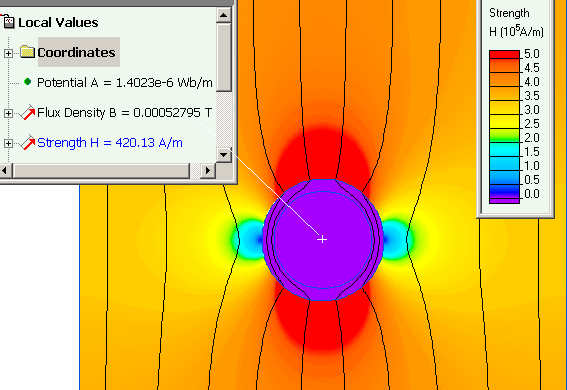
Magnetic field strength distribution in case of the transverse magnetic field
See more in QuickField for Electromagnetic Shielding Applications webinar.
Engineering question
Use an axisymmetric model for axial excitation and a plane-parallel model for transverse excitation, then compare the residual flux density inside the shield.
mu-metal cylindrical shields, low-field magnetic shields, precision instrument shielding
Download
Simulation problem
Problem Type
Axisymmetric problem of DC magnetics.
Relative magnetic permeability of mu-metal μ = 10000,
External field B = 0.5 T.
Determine the shielding factor for axial and transverse field direction.
Two problems were simulated: axisymmetric (mu_metal_rz.pbm) for the axial magnetic field and plane-parallel (mu_metal_transverse.pbm) for the transverse magnetic field. Uniform external magnetic field was defined by assigning non-zero vector magnetic potential on the simulation area boundary.
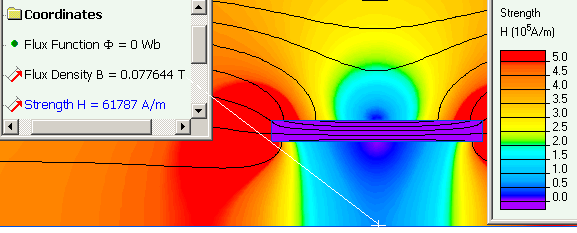
Magnetic field strength distribution in case of the axial magnetic field
Magnetic flux density
inside the cylinder shield
Axial field
78 mT (16%)
Transverse field
0.56 mT (0.1%)
Video
Related examples