Charged-Particle Motion in a Two-Magnet Penning Trap - QuickField simulation example
This example demonstrates how the QuickField Particle Tracer combines independently calculated electrostatic and magnetostatic QuickField solutions to compute the three-dimensional trajectory of a charged particle in combined electric and magnetic fields.
How to calculate charged-particle motion in a two-magnet Penning trap?
Answer Typical applications Geometry
Given
A fully stripped neon-20 ion has charge q = 10e ≈ +1.602e-18 C and mass m ≈ 19.992 unified atomic mass units ≈ 3.320e-26 kg.
Task
Solution
Results
The calculated particle remains confined inside the trap aperture. Its trajectory consists of fast cyclotron loops combined with a slower motion of the orbit center around the trap axis, producing the characteristic transverse motion expected in a Penning trap.
The free cyclotron frequency calculated from fc = |q|B/(2πm) is approximately 2.46 MHz.
References:
The model was created using the two-magnet Penning-trap design described by Tan, Brewer, and Guise* as a starting point. The publication provides the general arrangement and several principal dimensions, but not every dimension or all material data required for a complete numerical model, so the example uses a simplified engineering geometry.
Engineering question
Set up two axisymmetric QuickField problems, Electrostatics and DC Magnetics, for the Penning-trap geometry, then use the QuickField Particle Tracer to combine both fields and calculate the three-dimensional trajectory of a charged particle.
Penning traps, ion confinement, charged-particle spectrometry, mass spectrometry
Download
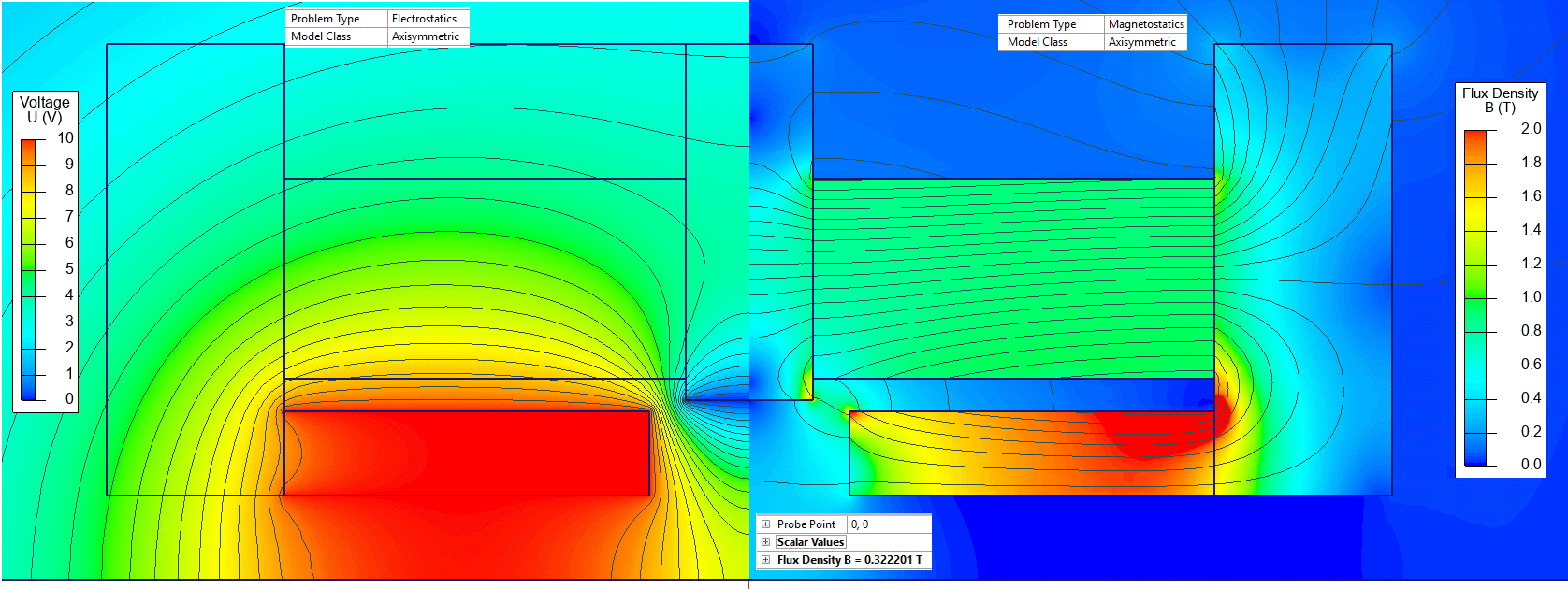
Simulation problem
Axisymmetric problems of Electrostatics and DC Magnetics, combined by the Particle Tracer.
The trap is built from a central ring and two endcaps (soft-iron), and two annular NdFeB magnets.
Electric potential difference ΔU = 10 V.
Soft iron with linear relative permeability μ = 2000.
NdFeB magnets coercive force HC = 742 kA/m, relative permeability 1.05.
Calculate the magnetic flux density at the center of the trap, then obtain the three-dimensional trajectory of the traced ion.
The electrostatic and magnetostatic problems are solved independently as separate axisymmetric QuickField problems.
The QuickField Particle Tracer then combines both field solutions and integrates the equations of motion for the charged particle under the Lorentz force.
The calculated magnetic flux density at the center of the trap is approximately Bx = 0.322 T.
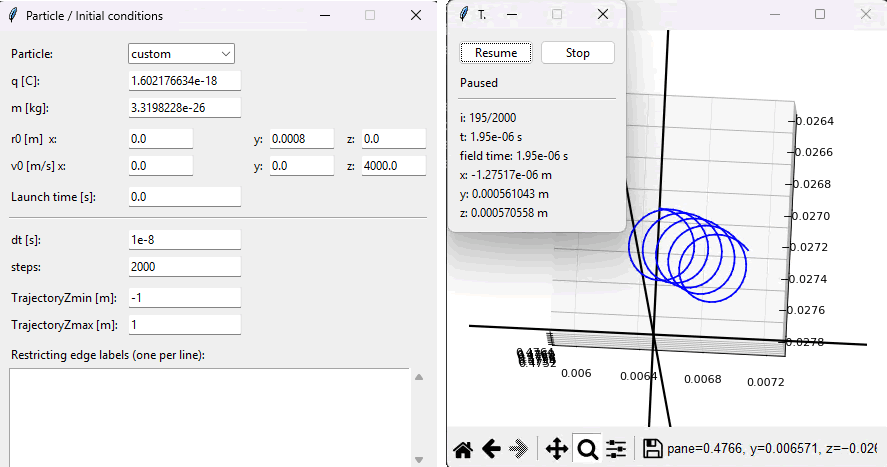
As a consistency check, the transverse coordinates y(t) and z(t) from the trajectory table were plotted against time; the average interval between successive maxima of y(t) is approximately 0.414 μs, corresponding to a frequency of about 2.42 MHz.
* J. N. Tan, S. M. Brewer, and N. D. Guise. Penning traps with unitary architecture for storage of highly charged ions., Review of Scientific Instruments 83, 023103, 2012.
Related examples