Relay dynamics simulation using Microsoft VBScript and Parametric Object Interface - QuickField simulation example
Relay-plunger motion under electromagnetic and spring forces, with VBScript and the parametric interface evaluating force throughout the plunger travel..
To combine the electromagnetic field analysis with the moving core dynamics both Microsoft VBScript and LabelMover are used. Interaction between LabelMover and Microsoft VBScript is performed using application programming interface (API).
How to calculate the relay's plunger motion using QuickField and Microsoft VBScript via LabelMover?
Answer Typical applications Geometry
Given
Task
Solution
The motion function can be found from second-order differential equation
The equations are solved in Microsoft VBScript. The dynamic link is used to invoke QuickField LabelMover and calculate the electromagnetic force at each step.
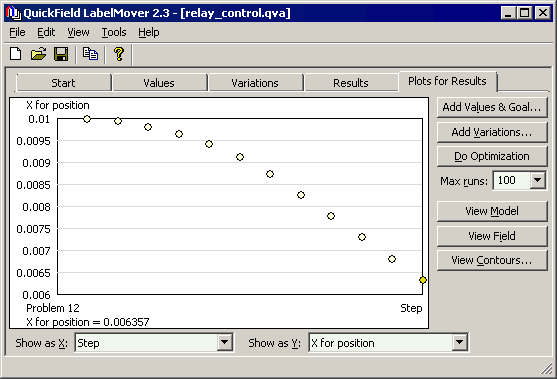
The calculations are stopped when x=xmin (pull in position, plunger hits damper).
Results
Engineering question
Set up an axisymmetric QuickField DC Magnetics problem and replace the multi-turn coil with an equivalent total current. Use Microsoft VBScript (via the LabelMover API) to integrate the plunger's equation of motion, calling LabelMover at each step to get the electromagnetic force.
electromagnetic relays, relay armatures, electromechanical switching devices
Download
Simulation problem
Problem Type
Axisymmetric problem of DC magnetics.
Current I = 400 Ampere*turns;
Plunger pull-out position xmax = 10 mm.
Plunger pull in position xmin = 6 mm.
Plunger weight m = 4.5 g;
Spring constant k = 4 N/m
Spring free position xspring.free = 15 mm.
Relay-plunger motion under electromagnetic and spring forces, with VBScript and the parametric interface evaluating force throughout the plunger travel..
The multi-turn winding is replaced with the equivalent total current.
m · d²x/dt² = f(x),
where m - is a plunger weight (kg),
x - is a plunger position (m)
f(x) - is the force acting on the plunger (N).
The force acting on the plunger is a sum of spring force fspring(x) = k·(xspring.free - x) and electromagnetic force.
The plunger hits initial position between 11th and 12th steps (0.055 - 0.06 s).
Related examples