Electromagnetic screen - QuickField simulation example
Multi-layered shield protects the equipment from the external high-frequency electromagnetic field. The shield should work in wide range of temperatures. Calculate the shielding coefficient as a function of temperature.
How to calculate the magnetic shielding coefficient of a multi-layer electromagnetic screen as a function of temperature?
Answer Typical applications Geometry
Given
Task
Solution
Results
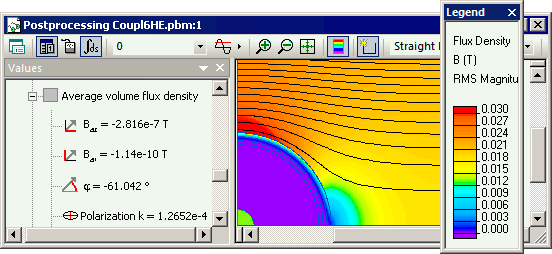
Magnetic field in the screen:
Engineering question
First solve a steady-state heat transfer problem to get the temperature distribution (since shield conductivity depends on temperature), then transfer that temperature field into an AC magnetics problem to compute the flux density on both sides of the screen. The shielding coefficient is the ratio of these flux densities.
magnetic shielding screens, EMC shielding enclosures, shielding material sheets
Download
Simulation problem
Problem Type
Axisymmetric multiphysics problem of Heat transfer coupled to AC magnetics.
Magnetic permeability of the shields μ = 1;
External field B = 0.03 T;
Frequency f = 4 kHz;
Ambient temperature range T = -100.. +100 °C;
Protected device temperature T = 20 °C.
Electrical conductivity of the shields σ - depends on temperature, as shown on the plot below:
The shield conductivity depends on temperature. Calculate the shielding coefficient as a function of temperature.
The thermal problem is solved for obtaining the temperature distribution. The result of simulation is transferred to AC magnetics problem, where the magnetic field distribution is calculated. Average flux density is calculated in the 'device' block. Shielding coefficient is then calculated as a ratio of the flux densities on both sides of the screen.
The external magnetic field is defined by the boundary conditions.
Temperature distribution in the screen:

Temperature
Flux density in device
Shielding coefficient
-100 °C
1.0e-8 T
3.3e-7
0 °C
5.2e-8 T
17.3e-7
100 °C
2.8e-7 T
93.3e-7
Related examples